Banglar Kantha: The Community Paper with the big punch

Banglar Kantha as a community voice of the Bengali speaking diaspora in Singapore over the past decade has been spearheading efforts in delivering community support services and cultural empowerment. This massive effort is the brainchild of Shri. AKM Mohsin, who with his dogged determination to get the difficult story, has attracted his set of detractors which is usual for a community activist and journalist. You would not be doing your job as a journalist if you are too pally with the constituencies, one is reporting against. In the midst of this backdrop, Mohsin Bhai as he is affectionately known among well wishers, has worked on the best stories with prominent international media houses including the Washington Post. He was recently cited in a Straits Times OpEd by the Singaporean Prime Minister Lee, in welcoming the Bangladeshi Prime Minister Sk. Hasina to the Lion City, as the locally run Bengali Language Paper. This is a testimony to the selfless work of Banglar Kantha to keep the Bengali language alive in the print discourse in Singapore. This is inspite the diaspora rather than with the support of the elite within the community, as Banglar Kantha is the voice of the subaltern migrant rather than a tabloid for the kitty parties of the diaspora elite. Grit, takes sacrifice and the underlying ethos of Mohsin Bhai is of service, which is truly one of a kind. I wish Banglar Kantha all the power, in the days ahead. Cholte Thako!

To Learn: Understand the Box

In order to think the so called out of the box, first define the box. We live in an age of Alt Facts and Post Truth, where the secular data point is twisted beyond recognition. Knowledge of the boundary conditions of the ‘Box’, helps us to detect bias. Too many of us shallow jargons and theories in a lazy manner, be it in engineering or in the social sciences. Thinking of the cognitive limitations, is the most hardest as it means jostling with our assumptions and thus the mighty educated ego. We all wish to feel good,however this is not the best mental state to learn. Vulnerability and Humility are starting points to authentic conversations with the Self and hence the community and the wide discourse. There is too little talk on authentic learning in the choppy waters of the corporate sector, where learning is ‘competitive advantage’ to score brownie points in meetings. But learning is emancipation in the truest sense. The Foucaudian perspective ‘Knowledge is Power’ is relevant but learning only takes place where existing assumptions are cracked open. Too much real insights are locked in exclusive networks of power.

Memory and Nostalgia in Qurum: Writing Muscat

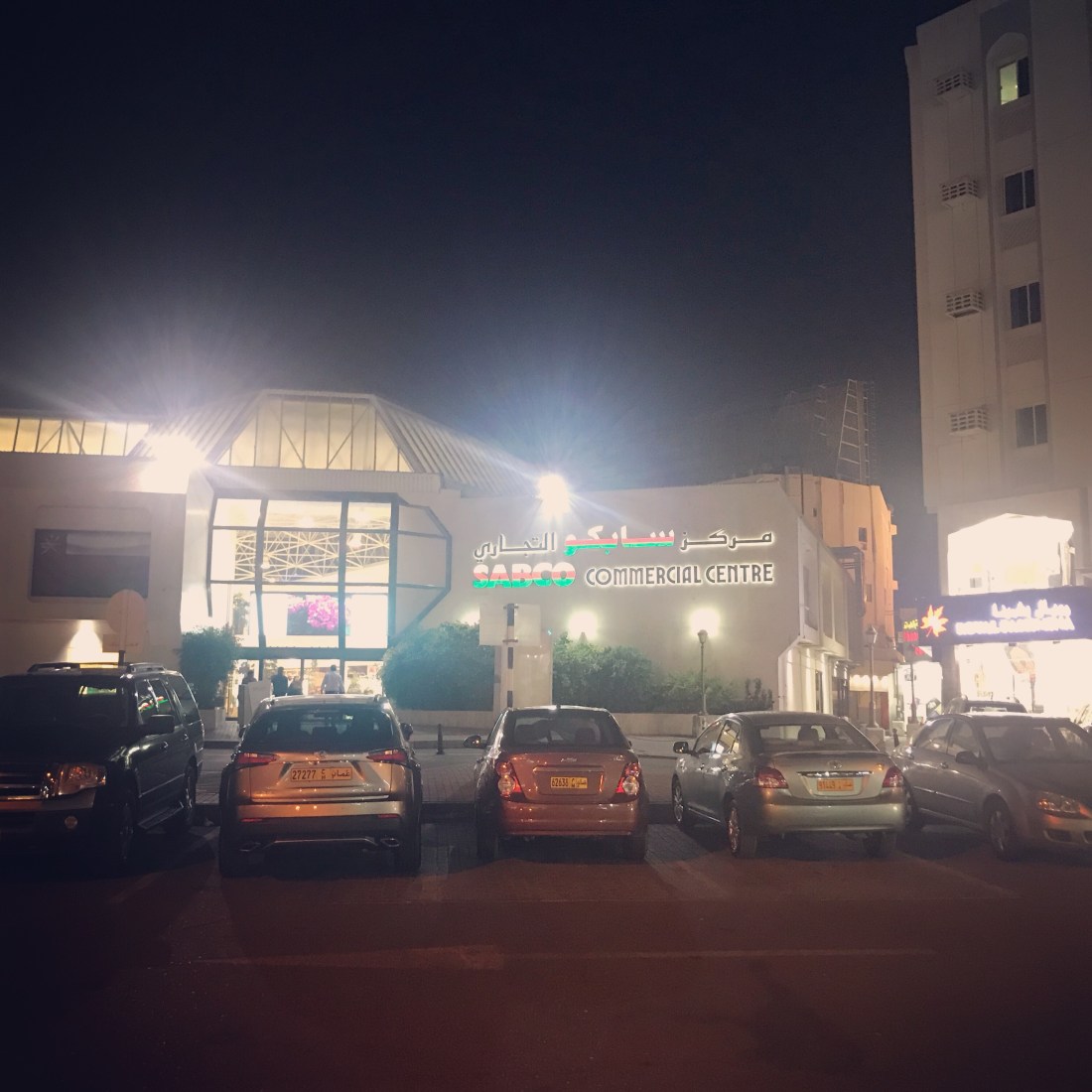
It’s a surreal feeling walking through the mall area of Qurum, of the Sabco and Al Araimi’s of the world where my teenage years and early twenties were spent window gazing at the Mount Blanc showroom or the posh optical shops, where honestly most of the products were aspirational. City Centre Seeb was too far, for a non driver such as me and Qurum is where most of the nice places to hang out were. Baba and Ma liked Qurum too due to the Park. The family friendliness and the good crowd accounted for the charm of Qurum.

Today, as I walked in to Al Araimi, the empty shops were a sharp contrast to the bustle of the late 1990’s with its sports shops and game arcades. I still recognised the Uncle at Raymond’s who made my ISM uniform as a kid.

The Armani store at Sabco was still great, pricey as ever and beyond my pay grade. The music stores were missing where I purchased my Khaled cassettes as an early teen. The mall with its renovations looks the same and is a touch point in traditional Modernity.

The walkability of Qurum, makes it a gem. Shah Nagardas with its stationary makes it a standout. Alexandria restaurant stands, where many take outs were taken.

Flaneuring has its perks.

Voices of Sustainability: Tales from the Green Front Line

The last two decades since Kyoto Protocol and the various COPs have brought Sustainability, Environment and Climate Change as everyday terms in our lexicon. Millennials and even more Centennials have green as a defining value. Pollution, the first order externality in which sustainability is primarily framed impacts ordinary people from Beijing to Delhi to Singapore.

Sustainability operates and intersects at various hierarchies from the public sector to the private equity firms integrating ESG data to compute risk. Every decade, sustainability as a paradigm, theoretical and pragmatic, ideological and operational evolves as it has a conversation with emerging themes of the day. The future of sustainability report, maps a few major drivers of the narratives impacting the discourse; agriculture and AI.

Asia, where I have worked in three distinct sub regions is on an infrastructure overdrive to give its millions a life which is aspirational. India has its smart cities to Singapore with its Airport T5 and Cross Island MRT Line to the KL-SIngapore HSR, looking to create a twin city hub by 2026. These mega infrastructure projects will need green professionals providing their insights to make these projects, seamlessly sustainable. The Environmental Impact Assessment Reports of Cross Island MRT Line and HSR are available online and I admire the detail of these voluminous decks. But I wonder as an Sustainability Professional; how many people are aware of our work? Are we a tick box measure merely? Or can we truly inform a green future by operationalising green, with tech innovation and economics.

Sustainability professionals are the foot soldiers of the green era. Our voices are tucked away nearly in analysis and footnotes. We should be vocal like our economist counterparts by being better risk communicators. I would suggest early career professionals to voice out their perspectives through blogs, contributing to eco NGO’s and steering the local conversations. For more senior professionals, contribute in informing decision making through new methodology’s in shaping insights and collaborate in a tri sector athletic manner. As the world rebuilds new constructs, sustainability professionals should be agile to respond to the times.
Writing The Gulf: Tea Corners in the Gulf

Tea shops around petrol pumps in Muscat are important social nodes of interaction over a 100 Bz Karak Chai and an Indian Savory such as Vadai. These petrol pumps are the end of the supply chain assets, which offer last mile connectivity to the consumer, in the global circuit of petrocapitalism, with epicentres from Vienna to the oil fields of Al Wusta in Oman.

Expatriate workers are feeling the hit of a low oil price environment, with fewer jobs and a constant stream of one way tickets back home.

These ‘Bachelor Bodies’ (Ye 2014) have a moment of life lived over small sips of chai and nibbles of samosa.

Writing the Cities of the Gulf need a language which is fresh and new, and decoupled from the lens of western anthropologists which analyse everything from an exhausted vocabulary of resource flows and globalisation. The gulf has its own nuances with a social conservatism anchored in, with the eyes looking to a future of innovation and entrepreneurship.

#migranttales

Pari, a review

Pari, the Anushka Sharma and Parambrata starrer is a horror firm within a larger story regarding south Asian narratives and a romantic dimension. It has a meaty ethical underpinning. Good direction by Prosit Roy in a kolkata backdrop with a Bengali star cast. The bylanes of South Kolkata and the Maidan was nice to watch.

The atmospherics were gripping with shock values. A bit stretched in the second half. I do not watch horror films but it was a refreshing change. Anushka has a winner on her hands and is surely doing a superb job as a content producer.

Do watch for the chills. Literally.

Crucial Questions for Entrepreneurship

Entrepreneurship in the recent discourse has focused on the exit and the valuation. The quick buck to be made, the Zuckerberg syndrome. Where as the traditional trader and the SME has anchored his/her business on longevity and sustainability. The marathon takes more than the sprint. The questions revolve along multiples and the sales targets. Legitimate to survival, but is the motive of the organisation the product, the corresponding impact and hence the money to raise more for an expansion or is it the exit itself. Are the employees in the game to create value or to create institutional careers?