In January 2015, I went on from being a petroleum industry consultant in Oman and India to a migration and health research lead position driving mini projects within a research program to bring issues of food security and migration experience issues with the Bangladeshi community in Singapore. This was my first formal brush with social justice activist leanings, as the earlier NGO/Social Innovation work I was leading was incremental rather than disruptive particularly in the area of communication and strategy. This experience in engaging with platforms such as AKM Mohsin’s Banglar Kantha and BoP Hub, led me to find out my strengths in working with communities. I just wish I had written more academically with my mentor Prof Mohan J Dutta at the National University of Singapore!
I hope to visit places in India and Singapore to meet peers and friends to take the conversation further whenever possible! Social Justice issues matter, as much as a check and balance mechanism in day to day life.
Every conflict zone is a human problem. The national security or the ‘independence’ lens really does not capture the torment of zero healthcare, zilch jobs and real absence of hope. The question to be asked is, is the land so vital even if the people treat you as oppressors? And the other question to the other end of the spectrum is: How do you envision life for your citizens after peace is achieved? Will the current revolutionary class be the new power elite ? Will the status quo evolve for the unemployed boy who throws stones for two hundred rupees?
I have been fortunate enough to work for Fortune 500 Consulting firms at one end of the curve to advising a migration non profit focused on cultural activism in Singapore at the other end. The bigger picture and the rhetoric, often boils down to dollars and cents during performance review, as donors/funders need to evaluate the ROI. We live in a business environment dominated by mega trends of political shocks, declining oil and commodity prices and flat value chains; where the consumer/client knows the set of data as you, the product manager. The information asymmetry between client and vendor has vanished. Machine Learning and Big Data is transforming the service economy, where specialists will dominate and entry-level jobs will disappear in the Fourth Industrial Revolution. In this scenario, operations is often under rated in the every day running of the business. They maximize the leverage available make sure the product/service is delivered at the right price point to the consumer. Ideas are simply not enough; there needs to be implementation excellence to unpacking the black box called value, easy to define, harder to deliver though.
Non Profit Platforms and Business Start Ups need to move beyond the ‘idea’ that they are pursuing whether it is a cause or a product and invest into expertise. The disruption has to be backed by professional teams, which focus on long-term bets, in value creation. The ‘Big Idea’ is brand equity but operating teams have to aggressive in funding, program management and innovation. Building teams and products that the market needs is the simple truth. Non-profits need to invest in operations as much as for profit peers. Being sexy is not cool all the time. Think Rahul Yadav, and contrast it with Martin Sorrell of WPP, who built a holding company around which brands evolved (HBR, July/August 2016). Have patience and do the right thing otherwise being out of business does not take time; the same advice is valid for careers too. The career of the entrepreneur follows a particular product lifecycle too.
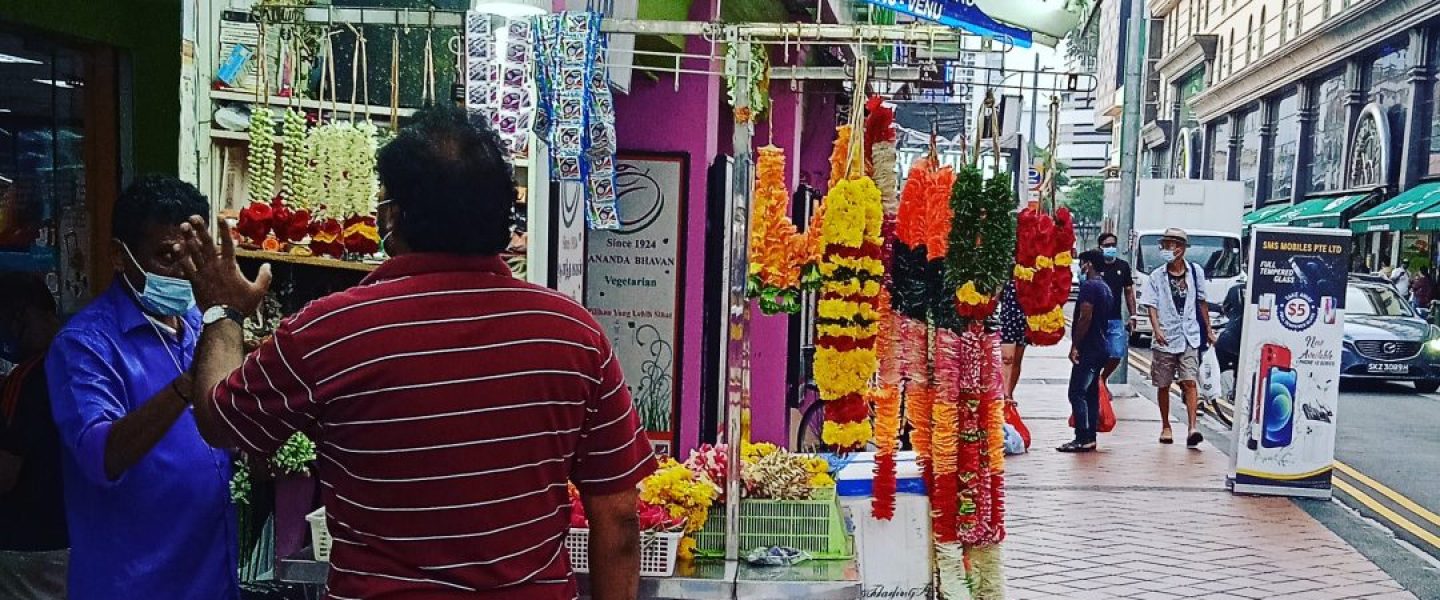
On a crowded Deepawali or Hari Raya eve in Little India, we can observe a sea of humanity passing by, the excitement palpable in the air and faces gleaming with joy. Festivals in Singapore serve as cornerstones of a multicultural society founded on respect for different beliefs and cultural affiliations.Various communities and sub groups within it have observed festivals as days to mark their togetherness and to celebrate diversity as the cultural fabric of this city state. In that nuance, festivals are registers of memory, emotion and a past that a person tries to cling to as time fizzles away like sand in a glass jar. I remember spending Hari Raya eve with Bangladeshi and Indian friends at Usman, a Pakistani food joint at the intersection of Desker Road and the main Little India fareway over masala chai and pakoras will 3am in the morning chatting away in anticipation of something more than a public holiday.
The Thaipusam procession along Veerasamy Road to Bencoolen with packed devotees and bystanders is a spectacle of culture and faith for the Tamil Hindu Community in Singapore.
Pic: Thaipusam Celebrations 2016 in Little India, Singapore (Photo: Author)
Likewise, the Bengali Hindu Community from India and Bangladesh celebrate Durga Puja in differing ways but the cultural importance of the festival is salient.
Hari Raya or Eid Ul Fitr is celebrated by different communities in their varied traditional flair, with the values faith, community and family as the bedrock after a month of prayer, penance and fasting. As a perennial migrant who has lived overseas in Oman and Singapore for many years, festivals were days i looked forward to engage as spaces of culture and memory along with donning the traditional attire and digging in to good food. Festivals serve larger purposes of social integration in multicultural societies as nodes of interaction between the mainstream and the margins of metropolis.
At the human level, Festivals are about celebration of values and bonding.
Writing is more than dishing out information, it’s about expression, aesthetics and shattering the silence. Mediocre writing is insincere at its heart. Great writing is not verbose, yet detailed enough, engaging and not indulgent. Writing is the mainstay of communication as we write emails, chat or write consulting reports. Great writing as a skills takes years of practice and mentoring by seniors who are amazing communicators themselves. Read material which expands ones imagination rather than sheer vocabulary. Writing after all is more than articulating data in words but about informing new visions for the future.
The entire point of work is to make a dent and not to simply warm the pews of the Church of life. The nature of work is changing; most jobs will be automated and service sector work will be replaced by bots and AI tools. The future lies in work which is meaningful and cannot be replicated by information technology and data which is not found on the Internet, rather insights which are there in the community through ethnographic work. Interview probes that make sense can’t be replaced by software. Impact lies in creative disruption and methods that are constantly innovated upon. The nature of learning has to change in order to avoid being jobless in 5 years time. Move to professions which are purely value driven by innovation and are people centered.
The fourth industrial revolution is changing everything through artificial intelligence. We better be shaping social infrastructure accordingly else unrest is only two skipped meals away.
Sanders is like Paul, with great optimism and no structural strength to carry all the way through. Inspiring ideas, do not get you the top job as in politics as business who you know matter and what you can do really does not. Only political entrepreneurial initiatives such as AAP can succeed as they back their ideas with action. Hillary is one sharp political operator, preparing the ground for years. I wish her the best against ‘The Apprentice’
Nil Battey Sannata is a damn good film. Swara Bhaskar as a trained Sociologist from JNU stars as a house help with a grit and determination with an aspiration larger than her reality. #NBS depicts the condition of government school education. The true measure of poverty is the paucity of dreams rather than a material construct. Good cinematography is a stand out feature of the film along with some solid performances. More power to indie films.
Trinamool is a novel political experiment now, rather than a resistance platform to the Left. Populist semi-socialist measures, minority support and strong leader from the urban fringes makes the appeal real. The corruption is a dampner and is not terribly attractive to the intelligentia although everyone in the Film Industry has been offered a political ticket by now. With an absent opposition, TMC is a monolith. The message which is missing in the narrative is that Trinamool is a Bengali Party, which the Left was not. A Malayali Central Leadership of the Communist Party, with Rajya Sabha seats from Bengal, was not taken by the Bengali middle class well. As much as JDU-RJD is a Bihar Project,NCP is a Maratha party and ADMK/DMK are Tamil Political platforms, Trinamool is a post ideological party, with Bengali voices in the legislature. The Alimuddin Street Culture was too elitist and removed from the realities of Bengal. The Left and the Congress are looking at the end of the barrel now in Bengal. Left won in Kerala as left is still alternative. In Bengal, it was not.
Poet Dr Gwee Sui Li opening a May Day photo exhibition
Mr. A K M Mohsin speaking about Dibashram’s work at Bicara Titian Budaya, a SG50 celebration event in December 2015
Singapore is a hub of economic activity in this region, with one of the highest Gross Domestic Product in Asia. Migrant workers from South Asia have been attracted to Singapore for its proximity to home geographically and due its higher pay compared to the Persian Gulf.
Migrants from South Asia in particular from Bangladesh are bred in a rich cultural milieu as the descendants of the artistic legacy of Kazi Nazrul Islam and Nobel Laureate Rabindranath Tagore. A normal Bangladeshi school going child composes poetry and song as a way of living due to the environmentally varied nature of the country rather than a special subject at school. Thousands of Bangladeshi Workers make Singapore their temporary home as guest workers to make their living. Half of them have a school-leaving certificate and a small number of them possess diplomas and college degrees.
These brothers often work at 18 dollars basic per day building and maintaining Singaporean Infrastructure in grueling sun and torrential rain. They have a voice which is stifled by structural constraints such as lack of fluency in English and being at the bottom of the labor hierarchy holding work permits, often at the mercy of the employer’s whims and fancies as their visa can be cancelled anytime. An average migrant in the construction and shipyard sector makes about 600 to 700 dollars per month. Often his salaries are not paid in time and take a minimum of two years to pay back the economic cost of migration back home.
I observe a lot of migrant related activity (if not activism) over the past one year in Singapore, with plenty of events, competitions and citizen centric engagements, which brings the migrant regularly back into the mainstream conversation. Most of these events are kind, create mini celebrities out of migrant brothers, who release books, music cds and perform in theatrical plays. We ‘like’ them on social media, sometimes without realizing that many of these brothers have attended college, and have been performing/published artistes back home. They are made migrants due to economic realities back home. I am fortunate to know them in person and is a delight interacting. They are also normal writers and artists who are innovative in plying their trade and have a day job to pay their bills. Many of the strategic diasporic elites do that too, right?
A lot of these famous migrants are nurtured by Mr AKM Mohsin, Editor of Singapore’s only Bengali Language newspaper Banglar Kantha and Founder of Migrant Cultural Space Dibashram who started off as a pioneer helping out migrants in the early 1990’s writing letters for migrants back home. He then started a community paper in 2006, to serve as the voice of the diasporic subaltern. His platform has helped catalyze the Migrant Poetry Competition and Migrant Awareness Week among other events.
Migrant Poets such as TEDXSingapore Speaker Zakir Hossain and newly minted author Md Mukul are products of the Banglar Kantha platform. They are invited to be toast of town at Poetry events at Artistry, a chic downtown cafe and national poetry festivals. This celebration is needed but how much of this celebration is helping redeem real issues such as injury claims and unpaid salaries?
Migrant literature as a genre promoted by Mr Mohsin and his cultural group Banglar Kantha Literary Association is a long term effort even when the spotlight was not shining. Migrant culture is a long term endeavor with sweat and toil, with lots of personal sacrifices with financial hits and burning volunteer weekends rather than one event every year for publicity sake.
Migrant activism should create space for silent conversations through cultural mediation rather a tick the box measure.


 Change Thinker