This is something that our popular neoliberal , consumerist culture fails to communicate that marriage and love, is not about a rock from tiffany or a honeymoon in the Maldives but its about companionship and sacrifice. A model from GQ only looks good on a magazine cover. In the end it is trust and the ability to reach an extra mile that matters. Do not commoditise love.
Human Values are universal. A Mother cares its child, a couple cares about each other. Globalised Cosmopolitanism have set expectation settings too far. The sociological imagery of a grand wedding and a life beyond means earned makes things rather unworkable.
Let us all be reasonable and try to understand a shade more. A relationship is not a product. It has a soul. Feel it.
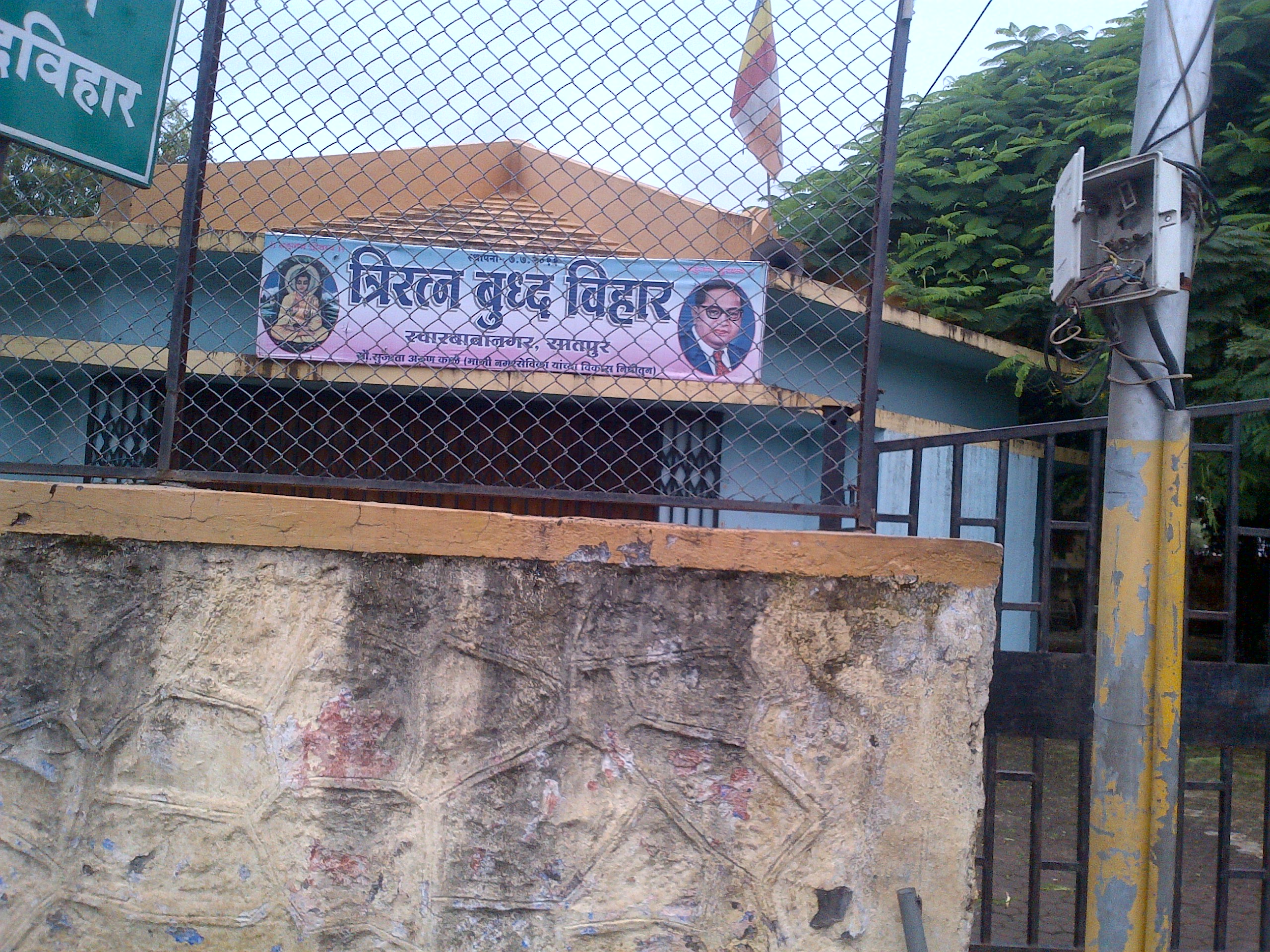
Pic : Neo-Buddhist Imagery in Satpur Village, Nashik District, Maharashtra
Urban spaces are melting pots. These places are objects of survival; an aspiration for the future is nuanced in everyday existence. The sights, sounds and the stark reality is surreal is every way, that one might confront the naked brutality of these interstial voids amongst lattices looking down on them. Jean Braudillard’s ‘Simulacra and Simulation’ and its characterisation of the proverbial ‘Desert of The Real’ is the primary intellectual imagery which comes to my mind. The poverty and its depravation-destitution is numbing although there might be a satellite TV desktop box in the box. No clean water but a Dish TV, the reality of everyday living in subaltern urban India it’s paradoxical at best- aspiration and destitution co-exist on both sides of the page.
Bhimnagar-Bhatpada is urban slum areas in Mumbai; nested between Saki Naka and Ghatkoper East in Mumbai. On top of a hill, easily visible to the airplane landing at the international terminal via its characteristic blue tarpaulins. These communities are characterised by its neo Buddhist symbolism- the shrine dedicated to Ambedkar and Buddha as differentiators from their marginalised history. The motor-cycle is as much taken care of as the sacred cow. Capitalism is a great social leveller as caste melts away in the face of cash, as Dalit Scholar Chandrabhan would quip. Public Toilets are social intersecting areas for building social capital. The early morning loo call is a social event as much as an intimate one. The mainstream political parties such as the Republican Party of India and the Bahujan Samaj Party; who claim to represent subaltern voices in the power structures of democracy have made their presence felt by the signages. I am not very sure if representation in democratic structures makes for real empowerment on the ground. It does on the other hand certainly present an opportunity as a social insurance against caste based discrimination. Often as the case in democracy it’s often the choice between the devil and the deep sea.
The Satpur Village adjacent to Satpur MIDC (an Industrial Zone) in the Nashik District of Maharashtra State in India is another example of the subaltern, social have-nots being collectivized and forging an alternate identity as a tool of resistance. Again out here Neo-Buddhist Imagery dominates the social mindscape. Subaltern communities are a crucial underbelly of urban capitalism as a manpower provider and a ‘Bottom of the Pyramid’ consumer base. That is the salvation of the market as when the politics does not deliver, the invisible hand does.
In response to a suggestion by a Good Friend; Here are my 10 favorite reads (not necessarily in any order)
1.A Great Clamour: Encounters with China and Its Neighbours- Pankaj Mishra 2. From the Ruins of Empire: The Intellectuals Who Remade Asia – Pankaj Mishra 3. The Man in my Head : Pico Iyer 4. This Divided Island: Samanth Subramanian 5. My Friend, The Fundamentalist : Sadanand Dhume 6. The Elephant Catchers: Subroto Bagchi 7. The Professional : Subroto Bagchi 8. The New Asian Hemisphere : Prof Kishore Mahbubani 9. The Malayan Breeze : Sudhir Thomas Vadaketh 10. India Unbound : Gurcharan Das
The Authors above have shaped the way i think, hence the way i write; being a self-trained writer, a owe a virtual debt to them.
In this age of Web 2.0 and democratized information on the smart phone, everyone is a citizen journalist. Take a pic, tweet an event and you are contributing to the discourse, a position previously mandated to the career journalist and the academic. The 140 character brevity does not help all the time as the messy, complex reality of our existence needs nuanced understanding of issues which are often tangled and inter-twined beyond any recourse. Facebook is more of an intimate platform with a Billion plus users, bringing out the narcissistic side in us. I must admit, Selfies are fun 🙂
Some friends on Social Media seem to voice opinion on every single data point from dog food to drones. The essence of research and writing of essays seems to a lost art, exclusive to the academic community and obscure journals which are seldom read. Culture Journals such as The New Yorker, Paris Review or The Caravan are rare breeds. We have limited attention spans, and a 2500 word essay written by Pankaj Mishra may render aesthetic pleasure but it is honestly cumbersome to read such art-pieces on a sub-way side.The audience is niche, not suited to social media blabbering. The 24×7 information machine makes it impossible for a thought leader or a public intellectual to remain consistent, Fareed Zakaria can surely attest.
In depth understanding of a policy matter is mandatory to make an informed call. TV Punditry is sexy and I have been on international TV personally but experts are experts. Hard Work has no substitute.
Let us pass a statement when one knows something substantial. Democratising information is one aspect but information pollution overload is another.
Last week, I had traveled to Goa and Belgaum in northern Karnataka for work. Well, my day job takes me to interesting places. The hilly drive to Belgaum and back to Goa in a day was simply enriching. Goa is very interesting place for an ad-hoc sociologist such as me who is fascinated by the evolution of culture and its associated norms and values. Goa is 65 percent Hindu, although its Portuguese Catholic Colonial Cultural Legacy is over-powering. North Goa along the Maharashtra Border is scattered with Hindu Shrines and Temples plus a few statues of Shivaji Maharaj- the great Maratha Hindu King dotted the landscape making its symbolic power very poignant. Northern Goa is very Maharashtra-wadi or Maharashtra Centric as the Konkan Culture pre-dominates the region. The Panaji bridge divides Goa geographically and metaphorically in many ways. Christian and significantly Muslim South Goa has the best touristy locales- beaches, churches and the casinos by the river like Deltin Royale. Economically prosperous yes, but it has been also at the receiving end of an exodus due to reverse migration to its former colonial master- Portugal and recently to Canada as a lot of Catholic Goans work in the Persian Gulf and they prefer to migrate to Toronto rather than return to sleepy Goa. The declining birth-rates in Portugal are to contribute for migration from former Lusophone colonies such as Macau and Goa. Globalization shows up another shade.
The BJP government lead by IIT educated technocrat politico Manohar Parrikar has emphasized the importance of improving road infrastructure but then been conservative in its approach in making it tourism friendly which is the economic staple of the Goan People. Upholding the Maharashtrian Konkanasta Sanskruti, is more vital than bringing in tourism dollars for Mr. Parrikar and his cabinet colleagues as our friend Mr. Rajesh who took us around Goa and Belgaum reiterated many a time the importance of the political economy of livelihood rather than the Sociology of Religion. No one including the author of this post is disputing the Hindu Fabric of this Nation and to not exclude Goa taking in to account its unique political history since 1961 when it ceded to the Indian Union, but to make Hindu Identity as the bedrock of governance is a bit far-fetched as about 1/3rd of Goa’s demography is Catholic. During the last Parrikar administration, Good Friday was made a restricted Public Holiday! No wonder Parrikar lost; this time thankfully he has been more accommodating as the Catholics of South Goa voted for him. This is incredibly surprising as Mr. Parrikar has cousins in Angola!
Dona Paula with its Singham memorabilia was noteworthy although Miramar Beach could be improved a bit. The commodification of Goan Cultural Symbols seems complete whenever one I met was out to over-sell Goa in which manner possible, although paradoxically, the place did not seem that way.
Goa as a theatre of Culture War is real, as two distinct cultures are vying for centrality in an area of pan Maharashtrian Regionalism. May the Best of the genteelness and gregarious character of Goan Ethos prevail?
A poster of a passport photo studio in central Panjim said it all about the post-colonial redux in present day Goa.
I rarely write book reviews although I read or attempt to read at least 4 full books a month. I rather distill the insights of different reads to analyse the complex messy reality around me. This approach helps me to write my book on urbanization and globalization and also helps to attract a regular readership on my blog.
This Divided Island by Samanth Subramanian, a Columbia educated India Correspondent of The National, an English Language Newspaper based out of Abu Dhabi is a Tour De Force of Indian Contemporary Writing based on the stark realities of the mess after the Sri Lankan Army’s demolition job of the Tamil Tigers and with it the complete subjugation of the minority Tamils in the East and the Northern Jaffna Peninsula in an aggressively Buddhist Sinhalese Sri Lanka. The Book is based on comprehensive fieldwork throughout the curvature of the Island the shape of a tear drop in two years after the Tigers were crushed with brutal thud of a hammer as if a mosquito is being squatted.
A first hand journalistic, but quasi-ethnographic account of personal accounts of survivors, stakeholders and civil society actors mainly commoners give this book a Pico-Iyereque Feel while the intellectual historiography of the Tamil Struggle in Sri Lanka is Pankaj Mishra-esque; both writers whom I deeply admire. The book reflects the churning of Sri Lankan Society and its new contours as a Buddhist Sinhalese Nation, where Muslims and Tamils of all faiths have to live by the dictate of the Buddhist Sangha and its radical advocates as the Sinhala Ravaya (or the Sinhalese Roar) where the Monks in Robes justify raw violence to squash any ideology other than the majoritarian narrative of the Aryan Sinhalese Race. The culture, politics, discourse and history is being recalibrated in accordance with the victors scale; this time is the Sinhalese Sri Lankan State. The 2000 year Tamil History in Sri Lanka is reduced to a footnote as signboards even in the Tamil North are in English and Sinhalese. The ‘Devala’ or Tamil in Sinhalese is treated as dispensable as can be read from the stories that the author shares in this narrative. The Book is divided into sections and sub-episodes and is aptly inter-linked to carve a smooth drive. The details of the book capture the war as a personal calamity rather than of cold political state-craft. The Terror, The North, The Faith, and Endgames aka the sections of the books are named with a specificity of a physicist gripping the essence of the write-up.
The most engaging elements of the book for me were the episodes narrating heart wrenching expulsions of the native Jaffna Tamil Muslims in 1990 on a summer afternoon and how the Buddhist Monks have justified War against Tamils on a racist/religion based rationale which renders a moral passport for state led so called anti-terror purges. Fanaticism of all shades it seems has the same colour. The racist justification it felt was the same as the Nazis had against the Jews and same fervour of medieval animosity of the Palestinian-Israeli Question. The Identity tangle brews bloodshed and similar non Buddhist activities such as riots against Muslims of the Arakan and Irrawaddy Delta in Myanmar by the neocon Buddhist Groups such as 969 have shown that extremism has no rationale.
I would recommend this travelogue thesis on post war Sri Lanka as an add to a serious readers personal library. A sure-shot contender for the South Asian Writing in English awards for 2014.
Recently, there were media reports last month criticizing the Greenpeace Executive who was flying between Brussels and another EU Capital for work every week whereas the commute could be done via a carbon effective route. So, much positive press for being environmentally aggressive on the high seas of the Arctic that Greenpeace is so known for. Last year, the esteemed UK based Charity Oxfam had advertised for an employment position for its Head of Communications with a price-tag of 75K Pounds. Staggering I would contend for a non-profit. But as the tribe of global, corporatized non-profits would retort they need to pay top pound for the best talent in the house. Partially true, but it would certainly not buy sympathy from a college going kid, donating his pocket money to satiate his green conscious. An industry executive whom I to spoke last week was point blank direct in labeling Greenpeace as ‘extortionist’ and questioned about the fuel bills and mobilization costs for the much publicized arctic expeditions. Genuine question indeed raised; which doubts the credibility of the moral entrepreneurship of Greenpeace.
Media Reports of Non Profit Training Seminars in Star Hotels where folks bleed their heart out on poverty while sipping chardonnay is simply not done. Well, one does not have to behave like an acetic, though this does not bring good press to the sector which depends on reputational capital and funder sympathy. Poverty porn creates cynicism and ultimately donor fatigue. In the effort to create ‘Shared-Value’, the non-profit movement has sold its soul to the devil that they so love to mock. The Social Entrepreneurship set-up is commercially not sustainable as there is too little real impact rather than fashionable fluff. They are good souls, but they tend to lose out in the crowd of wannabe do-gooders.
The lack of accountability and transparency in funding as informed by the leaked Indian Governments internal intelligence department report on foreign funding of Activist Non Profits that almost undermined so called developmental progress such as the nuclear power plant in power hungry Tamil Nadu. After Fukushima, the paradigm of risk and nuclear capitalism came to fore and a lot of activists rode the wave against nuclear power. A freshly churned MSF report on developmental interventions in crisis areas indicts non-profits as gunning for funding rather than concentrating on delivering the goods: creating an impact where state actors have failed.
It is time that Non Profits return to their core competence of creating impact, rather than rhetoric and function as true Force Du Resistance in empowering communities to realize their potential.
Every time i switch on to CNBC TV-18 or ET Now, there seems to be a common thread which the business media in India has picked up: portraying the amended Land Acquisition legislation as the demon strangling the animal spirits of Dalal Street Capitalism. Decade long job less growth and economic stagnation of the UPA has given the Modi Administration a free hand in terming every single device of the left of centre resistance as anti-growth. Growth-ism is a totem of our post liberalization culture. Well, there is a chasm between Dalal Street and Main Street. Let the bankers of SoBo visit the chawls of Virar first.
Transnational capitalism has a unique scripture and it has its zealots who preach the word on Bloomberg, Boardrooms and Business Schools. Anyone who has differing opinions is sidelined for un-natural profits at the alter of capitalism by marginalizing communities.
The priests of the bourgeoisie also get relegated to the proletariat of the middle class as was seen during the 2008 financial crisis. India needs manufacturing jobs and that is a reality which cannot be disputed.
Let the ambit of the conversation be broader and expand the boundaries of the discourse. That makes business sense and people are not statistics.
The past decade has led to an explosion in tri-sector interaction frame-works in popular business literature with leading American Policy Academic Joseph Nye exalting business leaders to re-frame their capabilities as a ‘Tri-Sector Athlete’; by adapting the requisite tools required for each sector to maximize shared value. The Private Sector under the wider conceptual rubric of Corporate Citizenship is working hand in hand with Philanthropic Foundations plus Global NGO’s and diffused citizen grassroots organizations to create an illusion of sensible corporate governance. Some drinking water here, some solar panels there is the current regime of tokenism. Social Development Professionals who work in corporate funded foundations and think tanks often complain of being sidelined by the marketing team who hijack whatever good can be achieved in a transnational shareholder capitalism context with green washing the naïve consumers. A serious empirical study needs to be done of how effective the rhetoric about ‘The Fortune at the Bottom of the Pyramid’ in the past decade has really been. The black box of management fluff needs to be deconstructed in order to understand whether the ‘real’ shareholders are being hoodwinked in believing thin air rather than real meat.
How real is the ‘Shared Value’ for the citizen sector? Is the value for the 3rd sector only in terms of paying the flight tickets and hotel costs of top honchos of Green peace? Let’s have some researcher do some Randomized Control Trials in a Monitoring & Evaluation Framework to know its efficacy.
As of now Shared Value has worked for Financial Institutions, FMCG Majors and Retail Chains to expand rural market share and procuring new targets (Grameen Group in Bangladesh has synergistic operating model- microfinance to dairy to telecom and rural renewable energy). I do not see how the power dynamics will work for the underfunded and undermanned non-profit in West Papua where the voices of marginalised communities are erased and co-opted in the name of Development for all in neoliberal governance architecture. Who is this ‘All’ after all?.
In order to operationalize this rather normative argument, let the corporations begin by making their current CSR initiatives more impactful by walking the talk, after all shared value should not be a footnote in its annual sustainability report, right?
The Food & Beverages Sector is the most segregated and stratified in the country as it ranges from the street corner fast food joint to a reasonable eatery to the ephemeral star hotels. An eatery has severe quality control limitations as an authorised eatery will have to get about 70 odd registrations and licenses done to open one. The F&B sector is glamorous with the Michelin Star Chefs sexing it up. Anyway the contemporary business media discourse is about eulogizing and manufacturing the myth of the entrepreneur. This post is about recognizing the potential for bottom up entrepreneurship in the ‘R’uban space and unpacking the black box of what makes an entrepreneur tick! (a term coined and popularized by Iconic Singaporean Architect & Urban Planner Tay Kheng Soon and recently quoted by Prime Minister Modi in his first Parliamentary speech)
The protagonist of the narrative is a certain Mr. Shyam who runs his corner store eatery in Gurgaon’s upmarket residential neighborhood, where he cooks and sells every single dish which the costumer demands. Costumer is King for him. Whether it is catering lunch to the office goer in the next block or the student who comes in for the rather oily fried Indian Noodles for an evening snack. 23 year old Shyam looks like a teenager due to his youthful dressing sense and negligible facial hair. His corner shop tries to deploy a modicum of a restaurant with the napkin, the silver foil container for takeaways, proper cutlery and outdoor cane chairs. Well, the family run store tries its best to attract quality crowd. Shyam once quipped that even if folks are not eating and simply sitting on the outdoor cane chairs, it will give a signal to the prospective buyer that the store has a clientele and hence shall infuse confidence aka validation in the store, that He/She may try out the place.
Brilliant business insight from a guy who just studied till Grade 6. Education has nothing to do with ability. Smriti Irani will make a great Cabinet Minister. A degree from Harvard or an IIT does not make for a good Entrepreneur or a seasoned politico (read some Mr. Kejriwal). Shyam left his town in Northern part of West Bengal at the age of 14 for Bangalore where he worked in a restaurant and learnt the tricks of the trade. In a few years, he moved to Gurgaon to start his corner store and moved up the social ladder.
Fire in the belly and being open to learning fresh ideas is the key to entrepreneurship. Humility, Drive and Risk taking ability are the traits that have distinguished Shyam from others of his habitus.
Simple Folks, Massive Insights. Entrepreneurship is a transformative social elevator.