The Subtle Politics of Migration

Imperial conquests by the European countries especially Great Britain left an indelible imprint on the Asian Subcontinent. Bengal was the first territory won by the British in 1757 at the Battle of Plassey, almost a century prior to the mutiny. Millions perished in the 1943 Bengal Famine while food grains were diverted to the front lines in Europe during the war.

Post Colonial histories are different in the sense the theaters of suffering have shifted. Post independence countries of the Asian Subcontinent did not meet the aspirations of their populace, with the noted exception of Singapore which is an economic miracle.
Countries such as Bangladesh which won its independence in 1971 is a major manpower exporter along with Philippines, Indonesia and Nepal in this region. Migration at any cost occurs due to economic despair. The burning hunger to provide for the family drives the migrant to sell precious assets to render the economic cost of migration.
The migrant arrives in his host country with hopes and dreams, often to be shattered due the unfair information asymmetry between him and the recruiting ecosystem. The exploitation begins from his village, often perpetrated by his family friend or distant relative. The migrant is at the bottom rung of the social hierarchy in the host country. He is the ‘Subaltern’ in this context.

He was not born a worker, as his family is capable to pay his migration cost. He took on hard labor oriented work as he wanted to earn his daily bread. He can write, sing, act and draw as he is a talent like any other.  The local activist sees him as resource for the ’cause’. His muted voice is co-opted in global advocacy themes. He does not understand the issue as his language skills are a barrier.

The academic converts his story into a case study and artiste groups are interested in performances which have an exotic element.

But where is the migrant in all these contexts? After all, He is the migrant who ‘can’t speak’ in a Spivakian vain.

A Year (of Writing) in Review

This day marks five years of this platform. I started the year with an audit in Sohar, Oman. Writing is what keeps me alive. In the latter part of January i moved to work at a Health Communications Think Tank in Singapore. This place gives me an opportunity to work on migration and health issues at the community level in Singapore. I love the work as it helps me to carve a dent in the ecosystem; work with non profits, activists, agencies and a superb boss who is an inspiration. I learn loads everyday. It is blessing.

I have failed too. Every new journey, tests me to the brink. I fail more and fail fast. I stretch myself, but i learn. But this has been an amazing year as i narrate below.

This year I started writing for Huff Post India, Corporate Citizenship Briefing UK and Banglar Kantha Singapore. I wrote about issues and matters which I am passionate about; migration, the region, sustainability & development and even forayed in unchartered intellectual territory such as International Relations. I have been volunteering and pro bono consulting with non profits this year, and these engagements give me the vantage point into unstructured learning and thinking a new.

I have certainly grown as a writer and researcher over the past year. I got married this year, and i have grown as a person thanks to my beautiful wife. This year has been very generous in terms of learning and growth. I pray for the same in the new year and hope to create a lasting impact in the years to come.

I end this year and half a decade of writing with almost 13000 hits. I thank my friends a Merry Christmas and Happy New Year.


A different SG50 Cultural Dialogue: Bicara Titian Budaya in Kuala Lumpur

On the 12th of December, Poets, Actors and Playwrights from Malaysia and Singapore met at a fancy art gallery Blackbox Publika in tony Jalan Dutamas area in Kuala Lumpur to discuss the role of the arts to foster community and social engagement in the SG50 spirit. This Artsy day event was sponsored by the Ministry of Culture, Youth and Sports, Singapore and organized by My Performing Arts Agency, Malaysia and Culture-Link, Singapore. Bicara Titian Budaya is a part of three month Titian Budaya Festival ending in January 2016 to celebrate Singapore Malaysia Cultural Relations.

The daylong event began by the hotel pick up at Royale Chulian Damansara, an upscale star hotel where the panel speakers were put up at. After the drop in a 16 seater Toyota Van to Jalan Dutamas and being warmly welcomed by the organizers, the panellists were briefed and then the day was ready to kick off. The audience was small and intimate, the seminar room at Blackbox Publika was inhibited by cultural practitioners and activists.

The day started with an engaging single person play ‘Serunding’ enacted by Singaporean Actor Aidli ‘Alin’ Mosbit, written by young Singaporean playwright Ahmad Musta’ain Bin Khamis. It was the story of a Singaporean Malay Mother’s struggles with raising two grown up children in a religious manner. The play interrogated the role of cultural values in modern day Singaporean Malay families. A short but interesting Q&A followed regarding how the casting was done and the creative process behind naming the play Serunding.

A panel discussion on ‘Stories Without Borders’ followed with Singaporean Playwright Celine Wong, Singaporean Poet Gwee Li Sui, Malaysian Actor Jo Kukathas and Malay Language Writer Uthaya Sankar SB as panellists. This eclectic panel delved upon issues of limitations to their artwork.  Malaysian Actor and Playwright Jo Kukathas

spoke about her inability to receive large arts funding as her Singaporean counterparts, which restricts her ability to focus on a long term agenda.  Malay Writer of Indian decent Uthaya Sankar SB, spoke about how he was writing old and traditional Indian children stories in Bahasa Malaysia, which are reaching a wider audience within Malaysia. Singaporean Writer Gwee Li Sui touch upon something rather basic; the ability to churn out art that is authentic.

The day then moved to a short film ‘Beneath the Spikes’ produced by the RojaKrew Productions on a Father’s devotion to Lord Murugan observing the Hindu Festival of Thaipusam, in order to fulfil his vows when his son was saved. This emotional short film gave a glimpse of faith being practised in pragmatically oriented Singapore.

The second panel for the day was ‘A Socially-Engaged Generation’ with Singaporean Veteran Poet Alvin Tan, Malaysian Documentary Film maker Norhayati Kaprawi, Malaysia Cultural Activist Pauline Fan and Singapore National Arts Council Director Kenneth Kwok. The theme discussed in this session was focused on censorship.

The second and the last short film screening of the day was ‘Kuda Kepang: Reviving the Culture’, a short film on an ancient street drama art form which survives in Singapore amongst a minority in the Singaporean Malay Community.

The last panel discussion for the day was titled ‘Building New Hopes and Homes’ with Malaysian Social Activist Dr Hartini Zainuddin, Malaysian Community Arts Practitioner Liew Kung Yu, Singapore Post-Museum Curator Woon Tien Wei, Banglar Kantha Editor in Chief Mr AKM Mohsin and Banglar Kantha Contributor Manishankar Prasad. The Banglar Kantha Team delivered a short presentation on the culture and migration work in Singapore which AKM Mohsin facilitates.

This last session focused on the role of arts in the community and how art funders and their agenda’s potentially shape art.

The day event was a glimpse in to the cultural landscape in Singapore and Malaysia and how lessons can be shared across the straits. Art is a medium to discuss issues which are socially muted, and this event gave an opportunity to the arts fraternity to discuss issues which confront them.


Migrant Poetry Competition 2015: bringing the conversation ahead by celebration and critique

13th of December 2015 evening was cloudy and rainy, but for the migrant poets of Singapore it was an event to celebrate their voices with the Singaporean mainstream. With 74 entries this year in Bangla, Bahasa, Tagalog, Tamil, Mandarin and Punjabi up from 28 last year, and with 65 percent submissions by women; the competition expanded this year.

The competition was organized by Banglar Kantha, the only Bengali Language Newspaper in South East Asia and a group of volunteers that included Shivaji Das, writer and consultant and Charmaine Poh, a photographer. Banglar Kantha has been at the forefront of migrant literature and culture over the past decade and has been curating competitions/events in the field of migrant writing and literature since 2011. The concept of the competition was scaled up in 2014 to the general Singaporean public and hence 2014 was not technically the first migrant poetry competition. The event had 14 finalists from 6 languages and recitations included themes of separation from families, sacrifices, angst and somewhere an aspiration for a better life. The illustrious trio of judges were Academic Kripal Singh, Poet Alvin Pang and Translator Madam Goh Beng Choo. Shivaji Das opened the event evening by commenting that more has to be done to include other marginalised migrant workers.

The women finalists from Indonesia, Philippines and India spoke about guilt due to separation from their children and romantic love. The male participants spoke about sacrifice and nostalgia from home. They differed from their female counterparts in acknowledging disappointment from their anticipated experience of life in Singapore. One of two Chinese finalists wrote about how the egg he eats with his noodle in Singapore reminds him of the food of his hometown back home.  Last year’s second runner up Rengarajan from Tamil Nadu, India (a member of Banglar Kantha Literary Association) recited his narrative poem about the economic calculations of migrant life; the indebtedness that a migrant has to go through to make it overseas and how relationships never are normal for a migrant, as the transactional nature is always evident. He spoke:

“Ours is not a foreign life.

Our lives are foreign to us.”

Finalist Sandeep Kaur wrote in Punjabi about Female Infanticide in her untitled poem where she laid bare the patriarchal nature of society through an evocative plea from an unborn child.  The 3rd prize winner this year was a woman finalist from Indonesia who wrote about the angst of love in her poem ‘You’ which she passionately recited with great fervour. Her performance was powerful and shook the overflowing Level Five Possibility Room of the National Library Building at Bugis.

The male finalists are involved in construction work in Singapore and their female counterparts are Foreign Domestic Workers here.

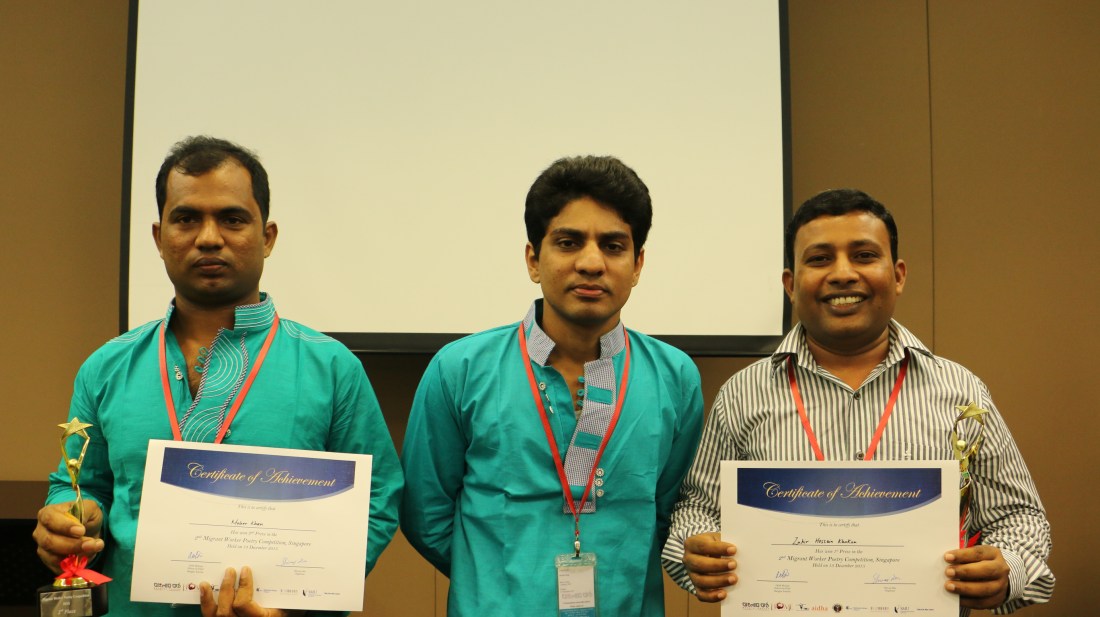
All the Bangladeshi Finalists Mohar Khan, Zakir Hossain Kokhon and Sromik Monir were finalists in last year’s competition too. All the three are mentored and nurtured by Mr. AKM Mohsin as members of the Banglar Kantha Literary Association; a volunteer writers group discussing migrant literature in Bangla.

While Sromik Monir (spoke about the labour of a migrant) won a consolation prize this year, Mohar Khan won the 1st runner up award for his poem ‘Lamp Post’ where he narrates that he is not merely a migrant but a financial support for his family back home. He wrote:

Day after day, my labour,

Has built this city layer by layer”

Zakir Hossain Khokon, last year’s winner repeated his feat this time around as well with his poem ‘I am Sorry’, where he paints an apologetic portrait of migrant’s work.  Both Mohar and Zakir’s poems were sophisticated in form and intense in meaning, and hence they stood out of the crowd in spite of the Philippine Finalists writing in English, which has greater audience appeal.

The evening had a small performance by Banglar Kantha artists on a 1971 Liberation War Song prior to the winners being announced. There were poems recited by migrant poets from similar competitions in Malaysia (organised by Banglar Kantha), Kuwait and China. The English translations were recited by students from United World College of South East Asia.

The event had sharing’s by the Cultural Affairs in charge of the United States Embassy in Singapore, who had sponsored the event. Melinda Page, shared that all should acknowledge the role of migrants in Singaporean Society. An American origin representative of the local Singaporean NGO TWC2 also spoke about the talents of migrants in the Singaporean workplace.

IMG_0109
Mr. A K M Mohsin speaking
IMG_3852
Mohar, Monir and Zakir (From Left to Right)
mohar
Mohar reciting his poem ‘Lamp Post’

Banglar Kantha Editor in Chief AKM Mohsin in his speech first spoke in Bangla exalting the Bangladeshi Community to unite in efforts to work for the flock. He then spoke in English delineating the difference between migrant literature and mainstream literature. Migrant Literature in his words was a platform to empower the migrant through culture. Most of the work written by the migrant is abstract and needs ‘curating to polish it into a gem’. Which in layman speak is mentoring and nurturing.

He encouraged the civil society to introspect in order to be impactful. Quoting from his speech:

“The question today to ask ourselves: Are we being authentic in helping our migrant brothers and sisters? Or is it cool to do this work. “

This call to move beyond ‘event activism’, is timely as the migrant needs continuous support for his cultural pursuits rather than a tiny blip on the radar, which is useful, but simply not enough.

Photos: Lopamudra Chakraborty Prasad

Conversation with Cabbie: Singapore Part II

Today I met a super smart Chinese decent Taxi Uncle whose geopolitical understanding is better than an International Relations expert. Spoke about Narendra Modi and his developmental agenda and his ideological convergence with east Asia. He said that ‘Development leads to peace’. He said he admired Narendra Modi as he was trying to clean up the Ganges by studying the Singapore model (Singapore River and Marina Barrage), and by beating lethargy out of the system on the same lines as Late Minister Mentor Lee Kuan Yew.

He also noted that Development in Singapore is about taking down 20 year old buildings to build new structures with the latest technology such as replacing copper wires with fiber optic cables. He said that newer MRT lines impact taxi driver incomes, especially along the more affluent Bukit Timah Road.

A proud Singaporean who said that his first duty is to protect the country. Respect. ‪#‎Sg‬ 

Writing as a mode of Activism: Do the structures listen?

“I will tell you this, I may be dead, but my ideas will surely not die.”

        – Saro-Wiwa, Ogoni-Nigerian Writer speaking to the tribunal that sent him to the gallows

I grew up in the milieu of post liberalization middle class India and the diaspora in the Gulf resembling  a similar socio-economic sentiment, which held the socialist ideals in great contempt as the economic ideals then were of the emerging Asian Tigers. The downfall of Calcutta from an industrial powerhouse to a pale former shadow, due to the policies of Left Activism such as ‘Hartals’ (Public Strikes) and a poor work culture; framed activism, and speaking for the margins pretty passé. I grew up in a household filled with Marx and Engels and ‘Das Capital’ being a prominent feature in our house library in Navi Mumbai. We did not have fancy couture furniture, but we surely had Marx.

Activism was framed in the 1990’s Star News and India Today fed discourse as a relic of pasts economic sins.  Activism was the forte of the chic ‘jholawala’ the well-heeled latte drinking intellectual usually a product of the famed Jawaharlal Nehru University, Presidency or a Tata Institute of Social Sciences with an Oxbridge or Ivy League degree. The other extreme was the grassroots activist working in the rural hinterland in India, with demonstrable sympathies towards the left.  This was ‘India Unbound’ in the words of Philosopher-CEO Gurcharan Das, as the IT/Engineering Major-MBA combo educated urbane Indian was out to seek his pot of gold (Humanities Majors in India simply do not make the mention even). The Infosys-HCL success story was shamelessly circulated a number of times.

The poor, marginalised Indian was not sexy enough for primetime news. ‘India Shining’ failure ushered in Left supported socialist politics of the Congress for a decade. More than secular progressive politics, graft and slow development dominated the discourse. It was known as the ‘missed decade’ by the TV Studio commentators. This was the decade that supposedly would have brought India in touching distance of China. We had a ‘Harvard Man’ in office, in the words of the most influential global justice activist and writer of our generation Arundhati Roy. Yet, unbridled greed filled orgy of graft derailed a government which had some good social welfare programs on ground such as MNREGA and Public Health initiatives which this Modi regime is dismantling in favour of private sector involvement, as Dalal Street dons wield influence rather than the aganwadi worker in rural Ratnagiri. Activists of all color as represented by the corporate media as road blocks towards the utopia of late capitalism. People displaced and killed by riots or by mega projects are simply footnotes in a report, gathering dust in a ‘sarkari’ office.

No one will scream ‘The Nation Wants to Know’ for the invisible Indian who cannot buy a share for a blue chip. Activism is not aspirational, the 42 inch flat screen TV in the living room is.

******

Activism and writing are connected with the common bond of language. The limitations of language is the limits of our imagination in the words of Wittgenstein.

The English educated elite dominate structures of power. I am one of them. English is not a language in India, but a ‘Class’. English has the appeal of connecting the average middle class Indian to the global circuit of capitalism. The IIT’s and IIM’s have their content taught in English and not in the vernacular languages. English bequeathed by our former colonial masters, has helped the South Asian diaspora to be enormously successful. We have had a rich literary tradition of Indian writing in English. Chetan Bhagat, the enormously commercial writer in English, has brought ‘Ingris’ to the first generated educated in India. He has democratized reading in English to the masses, however pop culture it might be.

But, the chasm between India and ‘Bharat’ is accentuated by the access to the English Language as well. English perpetuates an elitism driven by language, and removes the Lutyens Delhi elite from the conversation on the ground in Satara or Purulia.  There is a positive in knowing English as it gives the writer the access to engage the world.

How many vernacular translations do we read?

English has enabled us to converse with global commercial and political elite and sometimes challenge them. Access to the language has been us the cultural resources to challenge dominant thought processes of the times. Aruna Roy, Yogendra Yadav, Harsh Mander and Medha Patkar all speak in English to engage with the wider world with the stories of struggle and resistance and build solidarity with the movements of the global south.  Many an underground Naxalite leader has been known to be well-versed in English. Power is reinforced and circulated through the language, and writers have used this weapon to challenge the present, in the hope of a better future.

Does the knowledge of English alienate the urban Indian from having the consciousness of the marginalised?

Lobbying for social change, unfortunately needs the lexicon of resistance, and English is unfortunately the Lingua Franca for achieving this end. Ambedkar encouraged his followers to learn English as a tool to beat caste oppression. The language of the ruling class is not oppressive and emancipatory at the same time as it depends on the context. The subaltern who are erased from the mainstream discourse, often are erased due to the inability of communicating in the language of power. Writers although guilty of the ‘politics of representation’ in text, lend a voice to the silenced and this is the essence of activism; speaking up when all others are muted.

*******

Writing as a form of activism enables the helpless soul to speak to the structures of power, even if it does not listen. Rob Nixon in his seminal environmental justice work ‘Slow Violence’ writes

“In one of his final letters from detention, Saro-Wiwa assured his friend, the novelist William Boyd: “There’s no doubt that my idea will succeed in time, but I’ll have to bear the pain of the moment. . . . the most important thing for me is that I’ve used my talents as a writer to enable the Ogoni people to confront their tormentors. I was not able to do it as a politician or a businessman. My writing did it. . . . I think I have the moral victory.” “

Saro-Wiwa used his writing as a strategic tool to voice out the oppression that his Ogoni micro minority faced in the oil rich delta region in Nigeria. The oppressors were the state and multinational companies in his words. He faced the gallows as he used his writing as a tool for activism. The gallows did not silence his ideas of fermenting resistance. Silencing a writers voice, amplifies his message, and this creates the resistance he ultimately wishes to generate against the military dictatorship and the transnational oil corporation bed fellows, which have laid the delta region polluted and bereft of its natural ecosystem. Saro-Wiwa utilized his writing to force the structures to listen to him. Activism needed guts, which he had in ample measure. His death brought the focus on the oppression, which was the ultimate oppression in it itself.

His writing succeeded. Arundhati Roy in our times speaks against the ‘Upper Caste Hindu Corporate State’ that is India and sometimes speaks to Ed Snowden in Moscow regarding the Anti Imperialism Project, which she has so successfully written and spoken earlier. Her voice brings the global lens on anti-minority and anti-poor projects in India in a space where it is a rare flicker of hope.

Writing becomes impactful with guts. Activism is all about guts and intellect, hence writing and activism are good bed fellows.

Climate Change as a livelihood narrative

As a trained environmental engineer, am inspired by Amitav Ghosh and Arundhati Roy as writers who frame climate change in the language of humanities with an intense soul, rather than speaking about the 2 degree temperature rise as a dry statistical chart. Stories are the data of the soul. In Climate Politics season, it is time to engage to make a dent. Read of the Sundarbans in Amitav Ghosh’s writing in backdrop of climate change. Communicate better. Climate Change is a livability matter. ‪#‎COP21‬