Welfare, is not a bad word?

Welfare has unfortunately turned into an undesirable word in the political discourse from Delhi to Athens. The Greek public had an emphatic no vote to the EU Deal in terms of voting in the leftist Syriza. The Maverick Academic Finance Minister of Greece later had to tone down its rhetoric of leaving the EU. But, a bold voice never the less. A fresh breath in the hackneyed discussion. There are a few factors which brought Greece to its tether such as a huge bureaucracy but the structural transformation program (read brutal cost cutting) is simply humiliating for an ancient civilization. The Goldman Sachs instruments only added insult to injury. Since Narendra Modi’s BJP Government has come to power, Welfare has taken back seat. The Work for Employment Scheme aka MNREGA has been slashed as the Food Security Bill. While, Corporate Tax Holidays has increased in the words of Development Journalist P Sainath.

Even, the proposed projected 25.5 Billion Dollar outlay (Livemint, 27th March 2015) for the Universal Healthcare Plan in India on the lines of ObamaCare has been halted in the tracks. Billions of dollars can be spent for Defense and Tax Breaks but for treating a poor man for his heart ailment in a hospital is simply not worth it as is putting food on the table of the hungry, only to be feted by awards from the Davos Elite while sipping flutes of champagne. The AAP Victory is Delhi was a vote for welfare and compassionate capitalism where the urban poor in Mahipalpur near the airport wanted to have a voice in the discourse rather the  chic GK’s, ironically both in South Delhi. I have very been pro welfare in stance since a while especially on Food Security in October 2013 when I came on Al Jazeera to make a moral case for Food Security. Welfare is often the last resort of the poor and, inefficiencies and pilferage in the political economy of service delivery should not be used as an excuse to snatch away access to basic health care from the marginalized and subaltern. The Indian State is often a far away entity to the common man on the street and a void is often filled by faith based or community organizations in healthcare. There is a point to start and then iterate with the mechanics but do not deny the facilities if proper service delivery mechanisms cannot be constructed and maintained.  Building systems takes time and great systems such as the NHS in the UK and Social Security in the US have taken their own time. ObamaCare  or The Affordable Care Act has brought in 16 million additional people healthcare solutions. In a recent Atlantic article it has been argued that the social security cover has made America more risk taking and entrepreneurial. In this years Budget, Singapore which has been a poster-boy of free-market capitalism in Asia has nudged to the left with increased social protection platforms for its poor. The media coverage in the Singaporean press has been covering a lot of social stories including migrant worker food issues and ways to get the urban poor at better shot at social mobility. A new social contract for a left leaning Global City as a recent Strait Times Op-Ed quipped, should be real cool.

It can be said that the author has had a comfortable upbringing and what do i know about being poor. It needs empathy as the Middle Class is three skipped mortgage payments away from developing a class consciousness. Ask about being very little money in my account and without work and I do know what it feels like in that desperate situation. Corporate Tax Breaks and access to state infrastructure to develop industry and then call for government to be not in the business of business is a flawed argument. A lot of corporate profits are cross subsidized by the state ask the Gulf Owned Air Carriers. Private profits are just but feeding a poor man is a waste of money?

Welfare with proper checks and balances creates a more equitable society over the long term. Lets create more humane communities, one neighborhood at a time. A policy push sets the direction, and welfare plays a major role.

It’s a ‘Dammed’ affair: Energy, Politics and Development in Uttaranchal

In the past couple of weeks we have seen man made environmental disasters in two contrasting ecosystems in the Himalayan north of India and in the Urban & Ecological Jungles of Southern Malaysia and Singapore. The Singapore Haze Story is a man made healthcare scare and has had severe economic implications for the City State with a billion dollar hit according to Barclays. The Indonesians will perennially clear the forests for cropping and the rest of the region will to suffer unless a regional resource commons governance initiative propelled by hard cash is devised. The meritocratic and innovative Singaporean government lead by the PAP kept the population abreast of the air haze news by the minute through social media and a National Environmental Agency Smart Phone App which is commendable and a benchmark for disaster governance. The Government could not have done any more as it is a trans-boundary issue.  Quite a contrast to the abysmal standards of disaster governance at Uttarakhand vis-a-vis Singaporean standards of excellence.

The Tragedy was triggered by a cloud burst and torrential downpours in the Himalayan Uttarakhand State, which is a hydel power hotbed with numerous dams. These dams have amplified the ecological sensitivities which have contributed to the cataclysmic landslides, killing hundreds making the Uttarakhand tragedy a humbling experience for the priests of aggressive developmental drive paradigm. In a rush to feed an energy hungry northern grid, Uttarakhand led by callus leaders who ‘damned’ literally every available water stream dug their own grave, with the temple towns collapsing like a flimsy pack of cards. With job hungry Uttarachalis whose main occupation has traditionally aligned with armed forces, looking for work outside the government, the so called renewable energy industry came to the rescue. The same armed forces, which are India’s only Disaster Management competent agency, are now saving the day, in a nation which is woefully inept at saving ones backside. The Congress which is ruling the state with a wafer thin majority is all set to face the electoral music in 2014, with the state having ten seats for the Lok Sabha.  The important point being, that the congress is competitive in this state where in other places it is losing its deposit.

Environmental Issues are Force Multipliers. They might not win anyone one an election; but it will aggregate a small crisis to a regional disaster, which will surely make one lose a poll. Will the consultants/bureaucrats who did the environmental clearances for the dams be held accountable for this disaster? When will the corporate-political cartel take environmental compliance seriously?

Uttarakhand is an inflection point in the developmental & environmental governance narrative in this nation. It is time that we do not dust these lessons in to garbage bin of history and wait for another one to happen.

One Year@Maximum City, Maximum Experiences

Pretty much one year back, I dropped out of my second grad program in Sociology at NTU to rejoin the real world. I was not enjoying the program and knew intrinsically in my third semester in the last leg of my doctoral coursework that a course correction was needed. I love Singapore and everything about it and would like to move back if GOD presents me an opportunity. I took the leap of faith, and all thanks to the present organization I work for I moved back to the organized chaos of the city of my birth, janmabhoomi was to transform into my karmabhoomi. I have had a love-hate relationship with the city, never really felt comfortable here but knew that the city has had a valuable part to play in my manufactured psyche. The thing I appreciate about the place is the ‘Dhando-Wado’ spirit, a ‘can-do’ business type attitude, which makes this heart-less city function.

This city has made a man out of a boy. I have also had the opportunity to travel to some incredible places from Alwar to Anantapur thanks to work engagements.  These have been opportunities to re-explore India, meet some incredible people, make friends and mentors and this experience has enriched me totally.  But, somehow I feel, the time to explore is dwindling by the day and time to make a call for the long term has arrived.  

To be really honest, I never had the faith that I will survive the rough and tumble of Mumbai after a decade overseas of learning and growing up.  I landed up into an empty apartment, with a very global mindset and also took time to bear the emotional distance of being away from friends who are as close as family to me.  This time here has made me realize how much of a ‘Singaporean’ I am ; inspite of not even having a PR.  Education in a particular ethos and culture certainly leaves it signature imprint on ones values.  I long to go back all the time, and I visit the place as often as I can lah. I miss my Kopio at the Food Court at Sunset Way, Clementi.

Time has just flown by, for good or for bad, made me mature for tackling the difficulties of life.  I thank all my friends and mentors for guiding me through this journey so far.

I have cultivated an acquired taste for cutting chai now days, call it Singaporean Pragmatism at work.


Singapura: Field Notes from a personal journey ‘home’

Last week, I had travelled back on a break to the city, which really gave me an identity, a voice and played an in valuable part in shaping me through my two master degree programs. The place is Singapore and this city’s role in my consciousness was further intensified during my recent short break.

Ever since landing up in Singapore’s Changi Airport Terminal 2 I was warmly received by two old friends from my AIESEC Days in Grad School at NUS. We had a short chat over Peranakan Teh Tarik and Kueh at the Airport and then I made my way to my home for the next three days in Singapore. I was fortunate to have visited the Town Area of Raffles Place that afternoon for a meeting then headed to Arab Street for Iced Apple Tea Turkish Style and Beer later on at Blue Jazz Cafe.  Did I mention that I had the opportunity to partake in  authentic vegetarian Bengali fare for lunch too: P

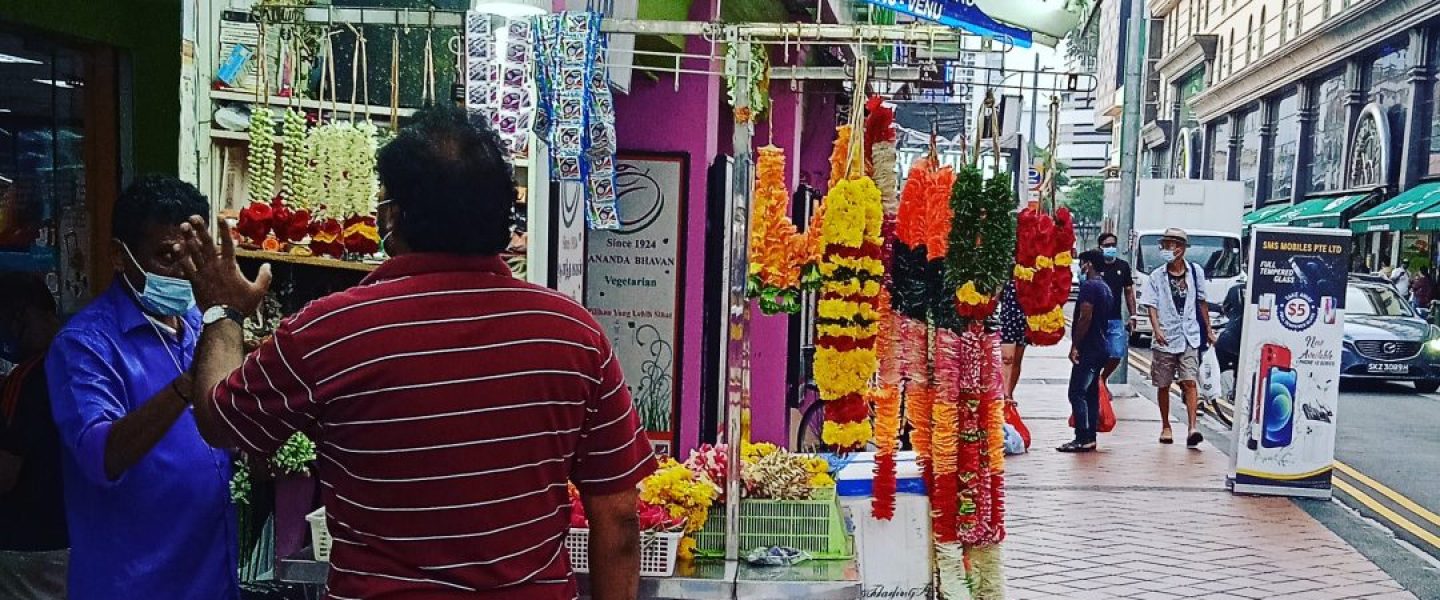
Singapore for me is not about the place, but about the people. My trip was made special by my Singapore Family, two friends who are truly my family there lah. None of the places that i have been this time in Singapore, would be without the blessings of the Singapore Family.  I felt at home in Singapore right from the moment I landed to the moment I had to leave.  From the Idly and Masala Chai at Tekka Centre, Little India MRT Exit C to the Hummus at Arab Street all felt home.

Singapore is the microcosm of Globalization, where can meet a Bangladeshi and a Global German speaking  Chinese Singaporean at Little India for makan on a Saturday evening over a Russo-Uzbek meal and then walk down to a North Indian Restaurant for Indian tea post dinner for an extended conversation.  A lot of my friends in Singapore complain about the place being boring and about the country undergoing a churning regarding identity. Well, my answer to them as a person who wishes to make Singapore home again, is that safety and discipline can make a place seem uninteresting but there is no counter price to good governance and law and order. And regarding identity, every young immigrant nation takes time to find it’s ‘ethos’ and its ‘core’.

Singaporeans are a resilient people and have well-wishers like me all over the globe. And I will be back for my dumpling noodle soup at a food court nearby very soon.

Mustafa Centre: A South Asian Expat’s Pilgrimage Centre

Mustafa Centre and its founders are the stuff of folk lore of the Singaporean Indian Community. From a small store in the 1970’s as my mariner uncle tells me to a behemoth on the entire Syed Alwi Lane, Mustafa has come a  long way. A recently read a couple of articles in the Indian Media on Mustafa Centre. It hit upon the right notes; it is crowded, a package tour ‘tourist’ haunt, can shop for veggies and masalas from Chennai at 3am in the morning. I agree with all these observations. For a recently returned Indian Expat from Singapore, Mustafa means a lot more. It means a one stop shop, and a place to buy masala maggi and badam milk for me. But it is not the most inexpensive place to buy stuff, in Singapore. Convenient but not Cheap, i would quip.

A place to hang out on Deepawali and Hari Raya eve, having dinner at Usman and having chai at Mustafa Cafe at 2.30 am with friends. Priceless moments.

By the end of my stint in Singapore, i had a mind map of Mustafa at the back of head; what is available in B2 to where can i grab a bite on the top floor. The eateries around Mustafa- A Sagar Ratna to Bombay Cafe to Salimar- the menus were learned by rote.

A microcosm of South Asia can be found at Mustafa Centre with chirps of Bangla, Urdu and Tamil making up the cacophony which is a delight to my ears. It is a unique diaspora experience. The next cup of chai at Mustafa Cafe has to be soon.