Conversations with Cabbies: Social Policy Insights

Cabbies or Auto rickshaw drivers from Mumbai to Singapore are the most politically aware and erudite socio-political commentators that one can find as they truly have their ears to the heartbeat of the communities they drive in and unfortunately they are the most undervalued group in the urban ecosystem.

The point of contact/interface between infrastructure and transport policy, local law and order and the community, the entrepreneurial cabbie is a business on wheels. The chatty cabbie is usually interested in a good conversation and passing on his contact details (old school business development ) at least in India and the Gulf, in order to source for a long term ‘Bhada’ or a ride-rent in Mumbai Taxi wala lingo so that he does not have to seek out the retail costumer.

The well informed cabbie with tabs on the pulse on the ground is usually the person with the accurate grapevine regarding illicit activities, election trends or everyday activities in an area. I wonder sometimes, why does not the transport and urban planners of the world, not elicit feedback from these smart men regarding traffic density and other cues while designing, evaluating and planning urban infrastructure. Well, they are a tribe that are highly adaptable as any transport policy change and business model disruption (Think Uber and Radio Cabs) impacts these folks the hardest. The radio cabs have crippled the traditional Black and Yellow Cab (the legendary Kala-Peela) service that is unionized to a former shadow of past, a past where they ruled the roads of Mumbai. Or maybe the Mumbai Taxi wala did not change to the wind of the times. The newer radio cabs are more comfortable than the older ones.

About two years back, I had written two inspiring conversations with two cabbies and one auto rickshaw driver in Mumbai, regarding developmental politics and education as a social elevator. One of the Taxi Uncles I interviewed had a son who went to IIT Kanpur and then IIM Ahmedabad, and ran a private cab service, in addition to driving one himself.

Entrepreneurial cabbies cab earn more than hand to mouth as one Taxi Uncle in Singapore quipped because of the various peak hour, midnight and city area surcharges, but for that a cabbie has to drive for twelve to fourteen hours a day. Older cabbies can’t earn that much as it does not physically permit them to drive that long hours. In Singapore, driving a cab is often a post retirement job (or when you are out of work to pay the bills), and it takes time for the Uncle to learn the ropes, as I recently met a Taxi Uncle who retired a few months back.  Recently, a wise 62 year old ex-business owner Taxi Uncle a few days back discussed Singaporean resilience over the next 50 years in the ride back to Clementi from the central part of the island city:

“Singapore money very strong; Hospitals also run like company. All Indonesian Chinese go to Mount Elizabeth Hospital. Got lot of money. Mount Elizabeth Hospital aka MEH is also called the ‘Most Expensive Hospital’. Singapore General Hospital or Super Good Hospital and Tan Tock Seng Hospital as ‘Ticket to Heaven’ Hospital.”

The cost of Healthcare and Living is an undercurrent in the conversations here. A lot of educated folks drive cabs in both cities, which give an insight in to the kind of elitism which excludes people from white collared work.  A similar emotion is articulated even in Mumbai. Human experiences have a universal connect concerning survival and aspirations. The same socio-economic strata often migrate overseas to do blue collared labour in the Middle East and South East Asia. A fortunate few drive cabs in Dubai and New York, if they can find visa sponsorship.

I have had the most interesting conversations about the September 11th Singapore Elections with Taxi Uncles. I am always asked where I am from and what do I do here, and do I plan to settle down here. An important concern of the times we reside in, I understand.

Someone should do an ethnographic study of the taxi driver community. It will surely lead to some interesting insights. I love the music they play in the cab. Once a taxi driver Punjabi aunty was playing the latest Bollywood tracks, and I felt emotionally transported as if I was in Delhi.

With the era of driverless cars dawning in the next few years, will a huge swathe of people already disenfranchised by the service economy lose their jobs? A point to ponder upon indeed.


Paris, Mumbai, New York….. : Lives Lost and Lessons not Learnt

People die, become heartbreaks

People mourn, the next tragedy occurs

the past incident, the casualties become statistics

Academics and analysts research it in to a case study

All the Parties, invisible or visible

‘Non State Actors’ or Terrorists, boils down to suffering on both sides

And the media waits for the next news cycle

The politicos for the next election

The kin of the deceased the next meal……

New York. Mumbai and now Paris; violence has no geography. Let us not vent our anger due to the fear of small numbers now. Peace, Empathy and Understanding is what we need now. Prayers with Paris. Violence spills from the Levant to the streets of Paris. Occupation of Grozny leads to massacres in Moscow, and similarly the Kashmir Valley leads to blood spilt in South Bombay. Destruction of Iraq and Syria led to the migration crisis. Facebook launches a empathy filter. Where was the filter for Beirut, Baghdad or Lagos?

Where is this heading to? Inevitably, to the next round of drone attacks.

The Subaltern speaks to the Cultural Elite: Migrant Poetry at SWF 2015

Yesterday (8th November 2015) was a watershed afternoon for migrant literature in Singapore and South East Asia. The afternoon kicked off by Banglar Kantha Poets practicing by reciting poetry at Dibashram-Banglar Kantha premises. Then, as a cavalcade the Banglar Kantha Poets and volunteers with the community pioneer Mr. AKM Mohsin, the panelist for the Migrant Poetry Event at the Singapore Writers Festival started for the Arts House. The man who started Banglar Kantha a decade back, is the catalyst for many cultural interventions in the Singaporean Literary Landscape. The crew took the 147 bus, alighted four steps later from Rowell Road next to the Parliament and the Supreme Court, walked in to the august environment of the Arts House, in to the seminar room where we settled in.  Mr. Shivaji Das, travel literateur and co-panelist in the event and esteemed debate moderator Mr. Alvin Pang, made the seminar room a cultural space to contend with.

Shihab Bhai reciting his poem
The Singapore Writers Festival lending a voice to the cultural aspirations of the Bangladeshi Migrant Worker Community, is a recognition that the marginalized are finally gaining a foothold in the mainstream. The event yesterday afternoon started with five migrant poets (nurtured with Banglar Kantha Literary Forum support and resources) reciting their poetry of migrant angst and experiences.

Babu Bhai, Shihab Bhai, Mohar, Liton and Mahbub performed their poetry to the applause of the over flowing seminar room. The theme resonated with the refined crowd of intellectuals. After the performances, there was a panel discussion probing myriad aspects on poetry written by the migrant community with Mohsin Da and Mr. Shivaji Das, moderated by Singaporean Poet Mr. Alvin Pang.

The panel discussion focused on the motivations of migration poetry of the workers and the Migrant Workers Poetry Competition last year and also the upcoming event on December 13th. Both Mohsin Da and Mr. Shivaji are co-organizers of the event, which has expanded its footprint to various languages this year.
The audience questions touched upon critical themes of the Little India Liquor Ban and who is defined as a migrant? The cross-sectional audience raised the bar of the conversation to a different level. Many uncomfortable issues were broached; due to which the space for holistic understanding expands. The privilege which poetry as an literary art form accords.

This event expanded the discursive space for the migrant in Singapore by bringing forth the migrant voice in the discourse on ideas. This initiative fosters greater understanding and integration with the Singaporean core, a term popularized with the recent elections . This is indeed

The Panel Discussion on Migrant Poetry with Mohsin Da and Mr. Shivaji Das on Migrant Poetry

Mohsin Da’s and Banglar Kantha’s contribution to the Singaporean core.

Mobile, Mustafa and the Migrant in Singapore: Side-notes from the Globalization Narrative

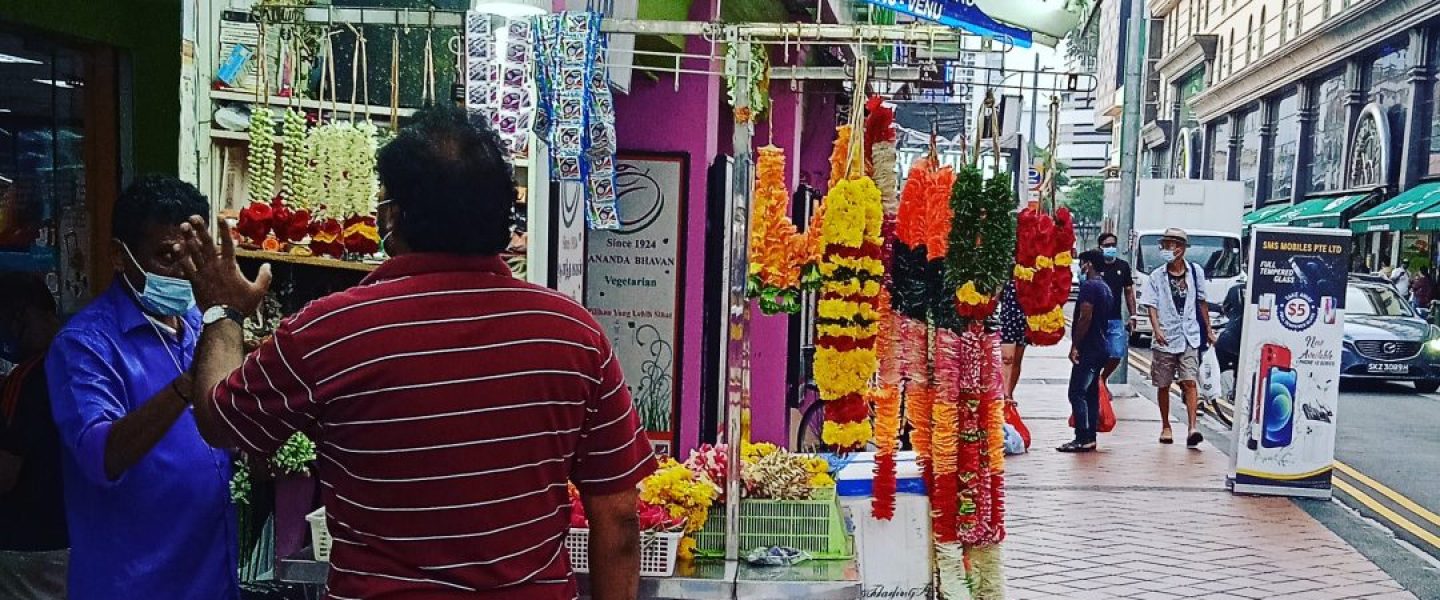
It was a crowded Sunday evening (as usual) in Singapore’s Little India area at one of the major bus stops perpendicular to the iconic Mustafa Centre on Syed Alwi Lane, the retail cathedral of the South Asian Migrant, which is also an organizing node for social interactions on the weekly off for the migrant worker. Evening was receding into the night, the bus stop was getting crowded by the minute with migrant workers from Tamil Nadu, Andhra Pradesh in India and Bangladesh as the sense that their precious Sunday has flown away and the early morning commute on Monday morning dawning on them. The motley cacophony of these different linguistic sounds define the ethos of the area, and which without any doubt is very South Asian. It is a lively part of the city, which may be too lively for my Singaporean friends who try to avoid the area on weekends due to the crowd and some taxi uncles have often complained to me regarding the sheer disregard that the migrants have of traffic regulations as the crowd often spills on the street. One taxi uncle of Indian decent once quipped: “This is not India, in Singapore you have to follow rules”. May be the impact of the Little India Riots a few years back is still fresh in the consciousness of people and hence there are  (recently imposed) restrictions on drinking liquor across the Little India area in Singapore on weekends after a certain time in the evening in the interests of maintaining public order.

These hundreds of thousands of migrant workers build and maintain Singapore’s global infrastructure such as the Marina Bay Sands, Public Housing Estates, Hospitals and Universities. But these workers stay far away from the city centre where they live in dormitories on the outskirts of the city-state near the Malaysia border. These dormitories are on the lines of integrated, self-contained townships some with even a cinema hall, screening South Asian Films at a subsidized cost. Not all the dormitories are that fancy though, with cramped accommodation being a defining characteristic. But, the Sunday ritual of traveling to the Little India area for the South Asian Migrant is a sacrosanct affair, and no matter the distance and the time required, the migrant will make it the Little India area to catch up with friends and buy their weekly provisions. It takes almost two hours one way on public transport to reach the Little India area from Tuas Industrial area on the fringes where the dormitories are located.

I really enjoy the atmospherics and the cultural milieu of spending Sunday in the alleys of Little India perching my self next to Khana Basmati, a prominent Bangladeshi Restaurant frequented by migrants, as I observe deep fried and oily snacks (Bhajiyya in Hindi or Tele Bhaja in Bengali) being sold as hot cakes. The fried snacks however brutally unhealthy are lukewarm but remind me of street food in Mumbai/Kolkata. Hence, on a Sunday late evening a crowd of workers converged on the bus stop.

The Bus number 66 came; I was pushed and shoved without any regard for the orderly etiquette of the queue in Singapore, which reminded me of my days in a bus stop in South Asia certainly. The workers probably were panicking to grab a seat on the bus, as their journey back to the dormitory would take a while. The bus was theoretically a spacious, double decker one, but with hardly space to breathe, let alone breathe.  In this rather limited space, my South Indian looking neighbor took out his android phone and started reading the news on Dina Malar website, a prominent Tamil News Paper in India. Within my eyesight as well, I saw a Bangladeshi man reading news on Prothom Alo Online, the premier Bengali Language Daily in Dhaka. I saw a few others too reading news on the phone during my thirty-minute bus ride with my South Asian compatriots. The migrant keeps in touch with the daily developments in his home country due the smart phone and the reasonably priced high-speed 4G data connectivity in Singapore. Almost every migrant carries a smart phone now a days, resonating with the actions of Syrian refugees in Europe who will hold on to their smart phones at any cost, as it is their last connection to their old lives.

sunday little india Migration is a development resulting out of poor employment opportunities in their home markets and slightly better pay in manpower importing countries such as Singapore. The feeling on being connected with their families on Skype on their phones (such as one I saw on the bus) or reading the news of their native districts back home, surely make the burden of being a migrant more bearable. I am a second-generation economic migrant with my wife in India and parents in Oman, and do understand the sentiment very well.

An Artsy Sunday Afternoon

Today was an usual Sunday Afternoon. I woke up late, grabbed lunch at my local kopitiam mamak stall out of sheer hunger having skipped dinner last evening. The lunch plate is modelled on the banana leaf, on which ‘Sapaad’ or the lunch spread is served upon in southern India. The plate however, was a melamine one, and the fish curry and the fried fish was bleeding colourful. The gravy was on the rice, just as I like it. The fried papad was crunchy.

The Anna or elder brother (as i address him) who runs the Indian Muslim Mamak stall at the Block near to where I reside at Sunset Way, was over keen and served an additional portion of chicken which was not needed honestly. I had this meal with my favourite ginger tea and the Sunday Straits Times, eagerly checking whether I missed any story online, which is there in print.

After a late lunch, i took a cab to avoid the heat to Little India to a space which doubles up as the office of the only Bengali Newspaper in Singapore; Banglar Kantha and the Cultural Space for Migrants- Dibashram, which translates roughly translates to as the day shelter for migrants. The Editor in Chief of the Newspaper Mr. AKM Mohsin, is a community pioneer, leading many cultural initiatives for the Bangladeshi Migrant Worker Community in Singapore.

So, i walked up to his office located at a strategic intersection on Rowell Road in Little India area, located above a popular Indian Restaurant where I drink tea whenever I drop by this area.  Mr. Mohsin had not arrived yet, so i wait for him while a couple of migrant workers play the harmonium and sing folk music loudly, all while i read Amit Chaudhuri’s ‘Calcutta’. Quite a combination and a prelude to the latter half of the day.

Mr. Mohsin walks in with Mr. Dewan Mizan, an art teacher and performing artist from Dhaka visiting the region on an exhibition tour. The artiste and a couple of 12004150_10207133714128919_7409693190157143696_nothers huddle up as they put together an exhibition of his sketches. The windows of the space converted in to an impromptu art gallery looked unique in a sultry afternoon

The plan was to perform art while a small skit was being performed by Bangladeshi Poets touching upon pressing issues faced by the Bangladeshi migrant. The Poets, enacted the skit in flesh and blood, with the flair of a professional, hardly revealing that they are battle hardened construction site engineers to boot. The emotional flair of oratory indicates a duality, typical of the migrant, who straddles multiple existences with ease.

It was surreal to experience the power of art, transform the ambience in an instant and bring out everyday issues in a silence shattering way.This initiative by Mr. Mohsin and Banglar Kantha/Bangladesh Centre Singapore/Dibashram is to be applauded as the event indeed was special.

I was on the introductory panel for the exhibition opening, explaining to the non Bengali speaking visitors in English. I believe though art transcends language, and the friends who did not understand Bangla, understood the vibe if not the precise content matter of the conversations.

Globalization has many downsides, but the confluence of migration narratives in an art form, certainly made my Sunday afternoon richer.

Why can’t there be more start ups that hack public service delivery?

Recently, i returned from Kolkata as a married man. I was out for lunch with my beautiful wife for lunch on Park Street, the tony shopping and leisure district. It rained intensely for 30 minutes and yes 30 minutes and the entire street was flooded till the knee. Me and my wife were mislead by the android phone GPS by 50 meters and had to walk in knee deep water for 200 meters  to Veda, for a lunch of Dhakai Murgi and Kebab. The lunch was spectacular with her. The silver lining in a  rainy afternoon. This experience has elevated my  thinking about the paucity of city level public service delivery in India, such as flood control, power access and basic sanitation & clean water. Bangalore has recently been feted as one of the start up capitals of the world by commentators in the global media. The Indian start up scene regarding e-commerce is damn hot. Flipkart, Snapdeal, Urban Ladder are everyday household names and money bags such as Softbank and Sequoia. Rahul Yadav formerly of Housing.com is a sex symbol for his radical antics. This media buzz regarding start ups especially Information Technology Driven have reached a frenzy that contributes to the myth of entrepreneurship. I believe that this myth does a disservice to the folks that creates products to meet a market need, and be accountable to the board of directors, consumers and the shareholders. Entrepreneurs are not responsible to the general public for anything else apart from delivering the correct product for the price rendered. Public Service Delivery involves Public Goods which lies exclusively in the domain of the elected representative aka the Government who swear by institutional memory rather than disruptive innovation. The United States Digital Service and its precursor comprised of tech geeks from the Silicon Valley had salvaged the Affordable Care Act aka Obamacare website whose website crashing every two minutes did not render justice to the revolutionary legislation. The internet is the interface between the government and the general public in the ‘Internet of Things’ paradigm. Start Ups such as Social Cops based in Delhi  bring Technology and Big Data to decision making in India. Information Management is critical to designing and delivering massive protection platforms, and biometric identity schemes such as ‘Aadhar’ in India add data to the mix and linking bank accounts to these numbers enables governments to channel cash subsidies to the recipient directly, although the marginalised poor would rather prefer the rice which he/she would boil and consume, Can the conversation regarding start ups move towards building solutions for clean water and sanitation, renewable energy and public governance? That would indeed be a game changer.

Bajrangi Bhaijaan: An Indo-Pak CBM

Bajrangi Bhaijaan is a breakthrough project in the Salman Cinemascape as it is a rare feat that a film that stars Salman Bhaijaan has minimal action sequences and is more an emotional experience regarding separation and inter-faith understanding. Leaves a tear at the corner of your eye with all the emotional bombardment on the senses with separation plot of a speech impaired girl (the talented Harshaali) who is super adorable like a doll.. This film is probably the most thoughtful film of Salman, after ‘My Brother Nikhil’ which was a cool decade back.  The film tackles deftly the xenophobic anti minority bent of the Sangh, the snobbish mentality of the upper caste Hindus towards non vegetarian fare and shows the humanity which often gets clouded by the veneer of religious dogma. Also, shows Sufism as a common ground between India and Pakistan.  Well done, Mr V Vijendra Prasad and Kabir Khan; the conceptualisers  of this rather off beat, yet mainstream story. With a dramatic ending, across the LoC in Kashmir, with the speech of the little girl being restored miraculously, the film carries a strong people to people message.

Pavan is the new ‘Prem’ of Salman now. after this performance. Salman’s fan following will bulge especially among a family audience. Nawazuddin Siddiqui again delivers a stellar performance redeming the film as the activist Sindhi Reporter who brings in the media angle by publicising the Bajrangi affair. The second half is a critic’s delight, while the first half was a Salman Khan Fan boy/girl video in the words of a dear friend. Bhaijaan delivers a clear break from a Kick, Ready and a Wanted; his popular fare mainly meant for a hardcore Bollywood Audience.

The cinematic treatment of Kabir Khan is macro, placing a human story in a geopolitical narrative. The India Pakistan theme continues from the last Salman starrer with Kabir, the uber successful ‘Ek Tha Tiger’ which I saw in a theatre in Vashi, Navi Mumbai twice. The biggest Confidence Building Measure India Pak Relations can get. Truly a ‘Being Human’ affair.  Narendra Bhai should watch this film with Nawaz Miyaan in their next meeting. 

Art has a unique ability to inspire hope and look beyond the prejudices of reality. Bajrangi Bhaijaan offers some hope in spreading Love and Understanding.

Charge your Market Rate

Never do anything for free what you know to do well about which there is a market need. Even for a start up or not for profit, even if they do not pay you make sure they respect your work and factor in your opinion. Otherwise, do your own stuff until there is a critical mass until folks need your skill set. Charge the market rate, that is the only respect that matters.

Empathy : The key to training your field leaders

Data collection is at the heart of the decision making business known as leadership. For a non-profit, monitoring and evaluation is a sacred ritual in order to renew its funding tap aka the grant. This post is primer in training your field leaders covering the bottle necks in designing and executing a field leadership program. I will first tap on the softer leadership challenges towards training the field crew, who are your eyes and ears on the ground.

There is a human connection to the data collection story; the local field workers who are cultural insiders and familiar with the culture of the region. Some of them might not be very well educated being merely literate at times and had not used a touch phones or a tablet before. Tech phobia can be very real as they feel that they might spoil the device (the psychological tyranny of using a pricey device, which is not very pricey). One more perspective is their inability to read the language interface in English although the questionnaire instrument might be in English. Understanding the device and empowering the field staff in accepting the tablet and the questionnaire is a fundamental challenge.

A real question asked by a Field Leader in the heat of the field:

“How do I save the data input file?”

Such a simple activity may seem simple to a digital native of an urbane Gen Y; but a barely literate but empathy rich Field Leader in rural Vidarbha is a challenge.

The soft power answer to training your Field Teams?  In my personal experience in training field leaders who are so crucial in the entire primary data initiative, good old empathy and confidence from the city bred university educated program managers towards their field leaders is so critical.

There are other critical issues while organizing a field training program apart from the softer issues such as logistical hassles in getting the projector working in the midst of a power cut. Taking note of having backup power such as solar chargers for laptops if the training is under open sky is critical.

Significant force multipliers in a training program:

  • Cater for Food. Food is an amazing connector
  • Have a fun break out session. Play Govinda songs to cheer up the milieu!
  • Have a training per-diem for the participants. Hard Cash Helps.
  • Make the training hands on. Do not preach. Do not.
  • The trainer should be a friend. The human connect matters.
  • Take the training environment as comfortable and at home for the training participant’s even if it means on spending a couple of thousand rupees more. Conquer the mind; the training will seep in better.
  • Most importantly, meet training objectives while having fun!

I hope this primer helps while your non-profit sets out on your next boot camp in the journey towards social change!

Conversations at Thirty Six Thousand Feet

Last weekend i flew to Kolkata for a break. It was a not very usual Friday evening and I was really charged up as I was meeting a real special person and compounded by the fact that I had not taken a break in a year’s time. It was a comfortable emergency exit seat with adequate leg room in a  tidy Singapore Airlines flight. The  pre-recorded Bengali announcement was in ‘sadhu basha’ or Victorian era Bengali which drew a smirk from NRI type Calcutta bongs who are more used to watching urbane ‘antel’ Srijit or Anjan Dutt cinema.

I thought that the almost four hour flight from Singapore to Kolkata would be an endless eager and excited journey in anticipation, which it anyway was. I had a few flutters in my stomach after a rather crazy week. But it was pleasantly punctuated with an abrupt focus group discussion, which organically started with my immediate next door neighbor across the not so wide aisle asking me ‘It is an interesting book’?’ (I had picked up a super pricey , but uber cool Monocle Good Business Guide at the Duty Free Book Shop). Then a brief conversation started off from what we do for a living and we figured out that I am a full-time Policy Researcher and the gentleman was a top shot IT Honcho who studied Aerospace Engineering at IIT Kharagpur but had worked in IT since the late 1990’s in India, Singapore, Thailand and the United States in core Information Technology. He had worked on building and re-building tech delivery platforms of ObamaCare and he recollected the painful ordeal of fixing a messed up system. As he was presently working at a financial services major now, he said that the challenge is not there but he has a semblance of a work-life balance. Yup, he traded in the fun for a happier wife.

The IT honchos  window seat neighbor was a sustainability architect working on building smart cities in India based at a premier urban planning firm. He also happened to be from my same alma mater at graduate school. The chilled out dude was heading out to Kolkata to get engaged to his long time partner. The fact that she studied at a local school in India and logged on a 2x salary compared to him as she is aha! again in Fintech, seemed to be a point of concern (Indian men will be Indian men).

The conversation revolved around from how there is no proper Healthcare access for the Middle America to how Decision Science is all about predictive analytic and that current day programming is about optimization of the equation influencing the curve, and doing manual calculations faster. Machine Learning, Public Health and Energy Efficient Buildings over Jim Beam and Red Label with diet coke and ginger ale at 40k feet proved that Bengalis can have ‘adda’ or a discussion; anywhere and anytime.

The IT Guy shared some real words of leadership wisdom with the two of us. He told us that focusing on what the organization needs, will help us to grow better rather than obsessing over details. Corporate leaders grow by focusing on priorities and making money is not bad, were real take aways from the discussion.

The icing to this rather splendid discussion was rather dashing Delhi based Air Stewardess in a smashing Serong Kebaya who joined us (with a particular interest in exploring what was I reading) and discussed Farhan and Zoya Akhtar films , writing and good reads for a good 25 minutes before landing in Kolkata. I am not very used to attention from Air Stewardesses although I have been a frequent flier as a consultant for many years.

Human beings have an innate need to talk and if the conversations are as cool as this, the better it is. Of course, an expensive full service airline ticket would not ensure this peculiar experience all the time.