
Reflections.
Through the Highways of Globalization
ESG with its profound strengths in measurability and reporting is the ECG test needed for a firm to understand the key growth areas towards responsible capitalism.
Growing up in Masqat, I ate lamb sam(b)osas which came in frozen packets and were the staple of any dinner starter, in particular Iftars. The veg versions don’t come close even now.
Oman, an emerging renewable energy Indian Ocean State has a rich Tarikh or a history to note. Mandvi in Kutch is 600 miles from Sur where the Sea of Oman becomes the Arabian Sea. An understanding of history will enable the post oil transitions which the climate era entails.
I grew up in Muscat and am involved in the intellectual life of the Khaleej in an engaged manner having worked on almost every leading infrastructure planning project as a social specialist in the past decade.

Happy to see the new HREDD regulations calling for an intersectional lens to transnational non financial risk in global value chains, as an engineer and ethnographer, the sociotechnical approach is rich in nuance as single issue topics give an incomplete perspective in an Uber Risk Society of climate, human rights and digital vectors.
Human Rights in Business is a context-based matter. It is not the radical social justice variant which the activists call for. This is more from a welfare standpoint, and the context is care. The job of a business to cater to its customers primarily while keeping in mind its stakeholders in the ethical vain. ESG is about doing business in the ethical approach. Human Rights is thus protecting businesses from a reputational perspective than correcting historical wrongs of slavery and colonialism. An understanding of history and culture is context for global businesses. The best branding gurus read ethnography and history to understand culture.
There is an enormous need for cultural understanding through history and ethnography for an effective social impact assessment for infrastructure. There is a tendency to be apolitical and technocratic, which is quite meaningless for effective participation.

The Gateway of India area hotels in Bombay serving dates and gahwa at the hotel reception, next to the Arabian Sea brings the whiff of the souks to the souls here.
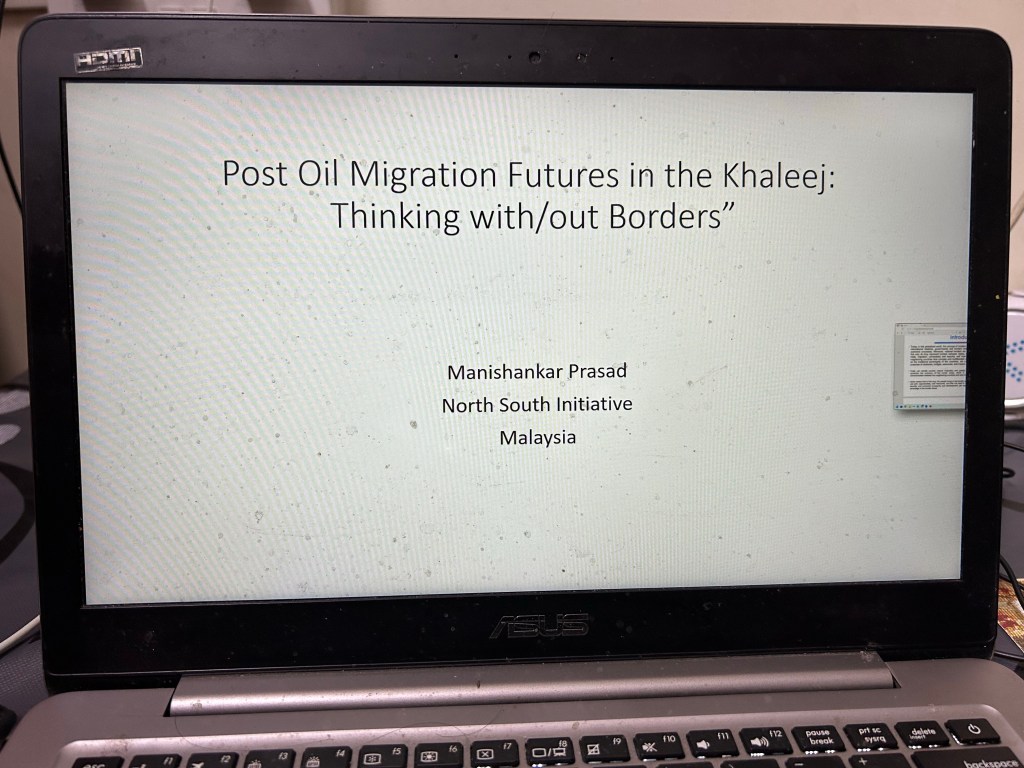
Such a humbling experience to speak at the University of Lethbridge Border Studies Group E Conference- ‘The Line Crossed Us’ on Racial Capitalism and Borders in the Post Oil Gulf.
Loved the kind, inclusive spirit of the congregation where academic solidarity rather than snobbery was in action.
Remote Conferences are a boon for scholars from the Global South, and the 11.5 hour time zone difference is bearable at 2.15am.
Loved speaking on the area of the world where I work and grew up in the Khaleej and there is so much interest as people want deeper insights rather than mere headlines.
There needs to be a dialogue between IFC Performance Standards, Equator Principles and MFI Safeguards or the world of project finance with the realm of ESG ratings and emergent frameworks such as CSRD and TNFD for better transition finance mechanisms.
The world of MFI lending will provide the patient capital for long durée climate transitions. The interoperability of ESG frameworks should act as a bridge to MFI Safeguards.
 Change Thinker