A different SG50 Cultural Dialogue: Bicara Titian Budaya in Kuala Lumpur

On the 12th of December, Poets, Actors and Playwrights from Malaysia and Singapore met at a fancy art gallery Blackbox Publika in tony Jalan Dutamas area in Kuala Lumpur to discuss the role of the arts to foster community and social engagement in the SG50 spirit. This Artsy day event was sponsored by the Ministry of Culture, Youth and Sports, Singapore and organized by My Performing Arts Agency, Malaysia and Culture-Link, Singapore. Bicara Titian Budaya is a part of three month Titian Budaya Festival ending in January 2016 to celebrate Singapore Malaysia Cultural Relations.

The daylong event began by the hotel pick up at Royale Chulian Damansara, an upscale star hotel where the panel speakers were put up at. After the drop in a 16 seater Toyota Van to Jalan Dutamas and being warmly welcomed by the organizers, the panellists were briefed and then the day was ready to kick off. The audience was small and intimate, the seminar room at Blackbox Publika was inhibited by cultural practitioners and activists.

The day started with an engaging single person play ‘Serunding’ enacted by Singaporean Actor Aidli ‘Alin’ Mosbit, written by young Singaporean playwright Ahmad Musta’ain Bin Khamis. It was the story of a Singaporean Malay Mother’s struggles with raising two grown up children in a religious manner. The play interrogated the role of cultural values in modern day Singaporean Malay families. A short but interesting Q&A followed regarding how the casting was done and the creative process behind naming the play Serunding.

A panel discussion on ‘Stories Without Borders’ followed with Singaporean Playwright Celine Wong, Singaporean Poet Gwee Li Sui, Malaysian Actor Jo Kukathas and Malay Language Writer Uthaya Sankar SB as panellists. This eclectic panel delved upon issues of limitations to their artwork.  Malaysian Actor and Playwright Jo Kukathas

spoke about her inability to receive large arts funding as her Singaporean counterparts, which restricts her ability to focus on a long term agenda.  Malay Writer of Indian decent Uthaya Sankar SB, spoke about how he was writing old and traditional Indian children stories in Bahasa Malaysia, which are reaching a wider audience within Malaysia. Singaporean Writer Gwee Li Sui touch upon something rather basic; the ability to churn out art that is authentic.

The day then moved to a short film ‘Beneath the Spikes’ produced by the RojaKrew Productions on a Father’s devotion to Lord Murugan observing the Hindu Festival of Thaipusam, in order to fulfil his vows when his son was saved. This emotional short film gave a glimpse of faith being practised in pragmatically oriented Singapore.

The second panel for the day was ‘A Socially-Engaged Generation’ with Singaporean Veteran Poet Alvin Tan, Malaysian Documentary Film maker Norhayati Kaprawi, Malaysia Cultural Activist Pauline Fan and Singapore National Arts Council Director Kenneth Kwok. The theme discussed in this session was focused on censorship.

The second and the last short film screening of the day was ‘Kuda Kepang: Reviving the Culture’, a short film on an ancient street drama art form which survives in Singapore amongst a minority in the Singaporean Malay Community.

The last panel discussion for the day was titled ‘Building New Hopes and Homes’ with Malaysian Social Activist Dr Hartini Zainuddin, Malaysian Community Arts Practitioner Liew Kung Yu, Singapore Post-Museum Curator Woon Tien Wei, Banglar Kantha Editor in Chief Mr AKM Mohsin and Banglar Kantha Contributor Manishankar Prasad. The Banglar Kantha Team delivered a short presentation on the culture and migration work in Singapore which AKM Mohsin facilitates.

This last session focused on the role of arts in the community and how art funders and their agenda’s potentially shape art.

The day event was a glimpse in to the cultural landscape in Singapore and Malaysia and how lessons can be shared across the straits. Art is a medium to discuss issues which are socially muted, and this event gave an opportunity to the arts fraternity to discuss issues which confront them.

 

Migrant Poetry Competition 2015: bringing the conversation ahead by celebration and critique

13th of December 2015 evening was cloudy and rainy, but for the migrant poets of Singapore it was an event to celebrate their voices with the Singaporean mainstream. With 74 entries this year in Bangla, Bahasa, Tagalog, Tamil, Mandarin and Punjabi up from 28 last year, and with 65 percent submissions by women; the competition expanded this year.

The competition was organized by Banglar Kantha, the only Bengali Language Newspaper in South East Asia and a group of volunteers that included Shivaji Das, writer and consultant and Charmaine Poh, a photographer. Banglar Kantha has been at the forefront of migrant literature and culture over the past decade and has been curating competitions/events in the field of migrant writing and literature since 2011. The concept of the competition was scaled up in 2014 to the general Singaporean public and hence 2014 was not technically the first migrant poetry competition. The event had 14 finalists from 6 languages and recitations included themes of separation from families, sacrifices, angst and somewhere an aspiration for a better life. The illustrious trio of judges were Academic Kripal Singh, Poet Alvin Pang and Translator Madam Goh Beng Choo. Shivaji Das opened the event evening by commenting that more has to be done to include other marginalised migrant workers.

The women finalists from Indonesia, Philippines and India spoke about guilt due to separation from their children and romantic love. The male participants spoke about sacrifice and nostalgia from home. They differed from their female counterparts in acknowledging disappointment from their anticipated experience of life in Singapore. One of two Chinese finalists wrote about how the egg he eats with his noodle in Singapore reminds him of the food of his hometown back home.  Last year’s second runner up Rengarajan from Tamil Nadu, India (a member of Banglar Kantha Literary Association) recited his narrative poem about the economic calculations of migrant life; the indebtedness that a migrant has to go through to make it overseas and how relationships never are normal for a migrant, as the transactional nature is always evident. He spoke:

“Ours is not a foreign life.

Our lives are foreign to us.”

Finalist Sandeep Kaur wrote in Punjabi about Female Infanticide in her untitled poem where she laid bare the patriarchal nature of society through an evocative plea from an unborn child.  The 3rd prize winner this year was a woman finalist from Indonesia who wrote about the angst of love in her poem ‘You’ which she passionately recited with great fervour. Her performance was powerful and shook the overflowing Level Five Possibility Room of the National Library Building at Bugis.

The male finalists are involved in construction work in Singapore and their female counterparts are Foreign Domestic Workers here.

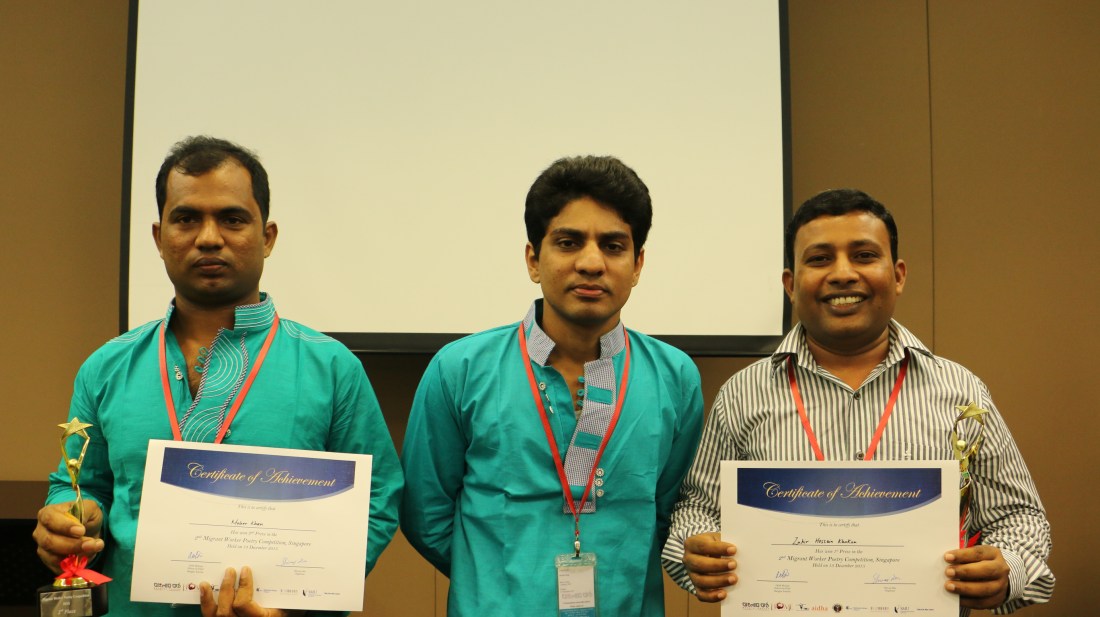
All the Bangladeshi Finalists Mohar Khan, Zakir Hossain Kokhon and Sromik Monir were finalists in last year’s competition too. All the three are mentored and nurtured by Mr. AKM Mohsin as members of the Banglar Kantha Literary Association; a volunteer writers group discussing migrant literature in Bangla.

While Sromik Monir (spoke about the labour of a migrant) won a consolation prize this year, Mohar Khan won the 1st runner up award for his poem ‘Lamp Post’ where he narrates that he is not merely a migrant but a financial support for his family back home. He wrote:

Day after day, my labour,

Has built this city layer by layer”

Zakir Hossain Khokon, last year’s winner repeated his feat this time around as well with his poem ‘I am Sorry’, where he paints an apologetic portrait of migrant’s work.  Both Mohar and Zakir’s poems were sophisticated in form and intense in meaning, and hence they stood out of the crowd in spite of the Philippine Finalists writing in English, which has greater audience appeal.

The evening had a small performance by Banglar Kantha artists on a 1971 Liberation War Song prior to the winners being announced. There were poems recited by migrant poets from similar competitions in Malaysia (organised by Banglar Kantha), Kuwait and China. The English translations were recited by students from United World College of South East Asia.

The event had sharing’s by the Cultural Affairs in charge of the United States Embassy in Singapore, who had sponsored the event. Melinda Page, shared that all should acknowledge the role of migrants in Singaporean Society. An American origin representative of the local Singaporean NGO TWC2 also spoke about the talents of migrants in the Singaporean workplace.

IMG_0109
Mr. A K M Mohsin speaking
IMG_3852
Mohar, Monir and Zakir (From Left to Right)
mohar
Mohar reciting his poem ‘Lamp Post’

Banglar Kantha Editor in Chief AKM Mohsin in his speech first spoke in Bangla exalting the Bangladeshi Community to unite in efforts to work for the flock. He then spoke in English delineating the difference between migrant literature and mainstream literature. Migrant Literature in his words was a platform to empower the migrant through culture. Most of the work written by the migrant is abstract and needs ‘curating to polish it into a gem’. Which in layman speak is mentoring and nurturing.

He encouraged the civil society to introspect in order to be impactful. Quoting from his speech:

“The question today to ask ourselves: Are we being authentic in helping our migrant brothers and sisters? Or is it cool to do this work. “

This call to move beyond ‘event activism’, is timely as the migrant needs continuous support for his cultural pursuits rather than a tiny blip on the radar, which is useful, but simply not enough.

Photos: Lopamudra Chakraborty Prasad